KTM and its related brands, GASGAS and Husqvarna, will survive. Its ownership will be in India, not Austria.
That was always the most likely scenario for a positive resolution of the financial problems that parent company Pierer Mobility got into. Bajaj Auto, the huge manufacturer of two- and three-wheel vehicles in India, already owned just under 50% of the Austrian manufacturer and has now arranged to provide an additional €600 million ($684 million), beyond the €200 million it has already injected, to allow the KTM conglomerate to pay off creditors. Pending regulatory approval, “Bajaj will shift gears from hitherto being a dormant minority investor to a majority owner in the global KTM company, whilst it continues to accelerate the thriving KTM business that is run out of India under the joint development program, where it develops, makes and sells in India as well as exports to 80 countries across the KTM network,” Bajaj stated in a news release. The exact percentage of the company Bajaj would own was not specified.
The cash infusion will allow Pierer Mobility to meet the terms of its financial restructuring agreement by paying its creditors 30% of the money due them. That payment is due tomorrow under the restructuring agreement. The KTM parent got into financial difficulty by continuing to pursue an aggressive growth trajectory and overproducing motorcycles after the temporary post-pandemic surge in sales softened.
So what does this mean for the future of KTM and its smaller brands? It’s certainly better news for anyone who owns a KTM, Husqvarna, or GASGAS, and even more so for dealers, than the alternative, which was the company potentially being liquidated. And while Bajaj will no doubt want to maintain KTM’s image as a performance brand with an “adrenaline-packed product lineup,” as Bajaj describes it, there’s also going to be more Indian spices in the cooking. Bajaj listed four plans:
Revamping management and “reconstituting” the board of directors. No surprise there. New ownership means new leadership and former CEO and current co-CEO Stefan Pierer will be leaving the board in June.
Bajaj will launch a turnaround plan “aimed at restoring momentum and competitive growth while driving the financial viability of the company.”
Bajaj will expand joint development operations between Austria and India and will be “pursuing synergistic opportunities.”
Pursue new collaborations and partnerships in the industry.
While we’re naturally hearing more generalities than specifics at this point, all those are the steps you’d expect new ownership to take to turn around the ship. Bajaj stated, “the larger role of Bajaj in the future of the KTM business offers potential to unlock a triad of opportunity covering global growth, brand elevation, and technology leadership.”
In any case, it beats a liquidation auction at the KTM headquarters.
When Suzuki’s DR-Z400S landed in showrooms 25 years ago, motorcycling was different. Fuel injection and anti-lock brakes were still only trickling in. The machine that won the World Superbike Championship made 120 horsepower in stock trim, and two-stroke machines left a haze of blue smoke in AMA Supercross arenas.
To be a valid dual-sport machine in the year 2000, a bike needed to be able to travel highway speeds and trot down a bumpy trail. A quarter century later, the on- and off-road space is crowded — from the handful of 300 to 500 cc ADV machines available to the hordes of gnarly off-road machines with towering seats and zero body fat — and many of the bases, or roads, are covered. This is the new school of multi-surface riding and, in order for the DR-Z to fit in, a makeover was in order.
The new DR-Z by the numbers
As far as the spec sheet goes, some things have changed and some things have stayed the same. A removeable, aluminum subframe carries all of the stuff at the stern, perched above a new swingarm.
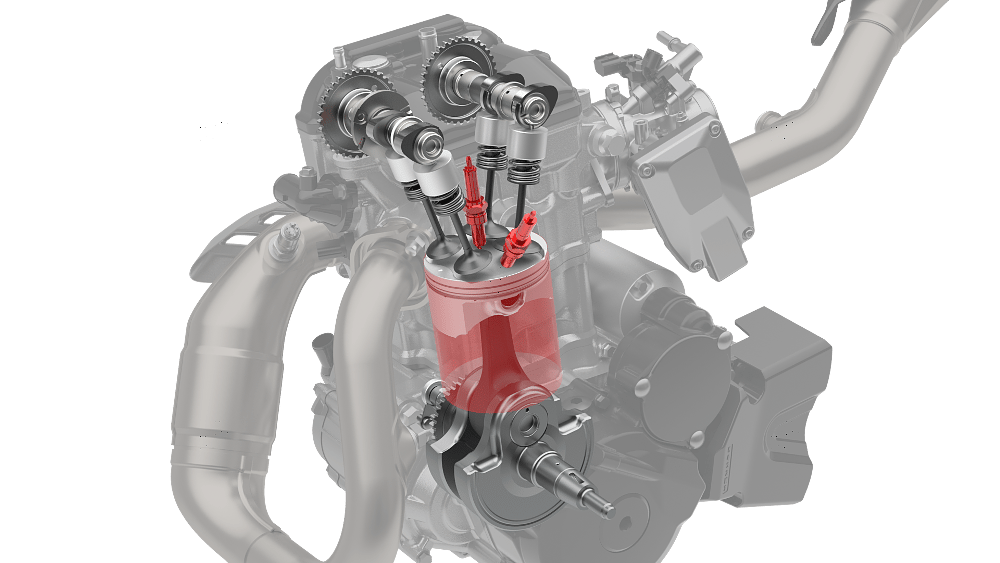
The engine itself has new valves, slightly more aggressive cam profiles, a dual-spark combustion chamber, and a new piston design, all of which is fed by a fuel-injection system via a larger throttle body and ride-by-wire right grip. That technology allowed Suzuki to make available three ride modes, three levels of traction control (plus off), and customizable ABS settings.
To pull the DR-Z out of the dark ages of Euro2 emissions compliance, the new bike predictably has an all-new exhaust system, with two catalytic converters integrated in order to meet Euro5+ standards. Because the outgoing DR-Z400 is a 25-year-old design, Suzuki had to reduce carbon monoxide emissions by 82% and total hydrocarbons by 90%. Big changes and, based on the expressions on the engineers’ faces as they explained it, a little bit of a pain to achieve.
All of this cost Suzuki some weight the fuel-injection upgrade amounted to more than 16 pounds and introducing ABS added about five pounds. Some of the weight gain was offset elsewhere, but it was a battle that involved a lot of one-step-forward, two-steps-back compromises.
All of the updates to the engine and powertrain highlight the broader dichotomy of updating the DR-Z. Part of the task was to make somewhat generic and obvious updates, like adding EFI and spicier cams, but at the same time it was crucial that everything worked together a lot more efficiently than before. Using titanium intake valves and reducing pumping losses in the crankcase by 20% sounds pretty racy until you realize that it’s all just to stay afloat.
Some good news is that the chassis updates thoroughly modernized the DR-Z with little to no downsides. There’s new suspension from KYB (fully adjustable aside from front-spring preload), a stiffer swingarm with a new shock linkage for more linear spring resistance, larger brake rotors front and rear, not to mention LED lighting. Also, some tweaked ergonomics the handlebar is 1.1 inches higher, the footpegs sit 0.9 inches farther back, and the seat has been made wider and lower by 0.6 inches each.
What’s a little different from most on/off-road bikes these days is the dash and switchgear. The two-color LCD display is humble, but packs a lot of info, and mates with a left control cluster featuring an up/down toggle and a “Mode” button. Street bike stuff.
There’s no denying that $9,000 is a lot to ask for a revamped dual-sport from 25 years ago. On the other hand, a quick look at the market shows a pretty big hole where the DR-Z4S is aimed. A buyer can get dual-sport bikes from Honda and Kawasaki for around $5,500, with lower seat heights, less suspension travel, smaller engines, and less advanced rider aids. You could also buy a KTM 390 Enduro R for the same price, and that might be a good option though it is a street bike dressed up as a dirt bike.
Or, there’s Honda’s CRF450RL, which only costs about $1,000 more than a DR-Z4S while having much more power and a serious off-road chassis. Then again, you’ll have to be ready to change the oil every 600 miles, climb up to a 37.2-inch seat, and don’t you dare let those revs drop or it’ll…! Crap, it stalled again. There’s always the Jurassic duo of Honda’s XR650L and Suzuki’s own DR650, for those who simply wish that things would never change.
The DR-Z4S calls for new engine oil every 3,750 miles and a check of valve clearances every 15,000 miles. It’ll also do third-gear wheelies on a gravel road, hop down a narrow trail or across a stream, and accommodate just about any rider’s desired delivery of 38 horsepower. Is all of that worth nine grand? From Suzuki’s standpoint, that hole in the market is either there for a reason, or it’s an opportunity to deliver.
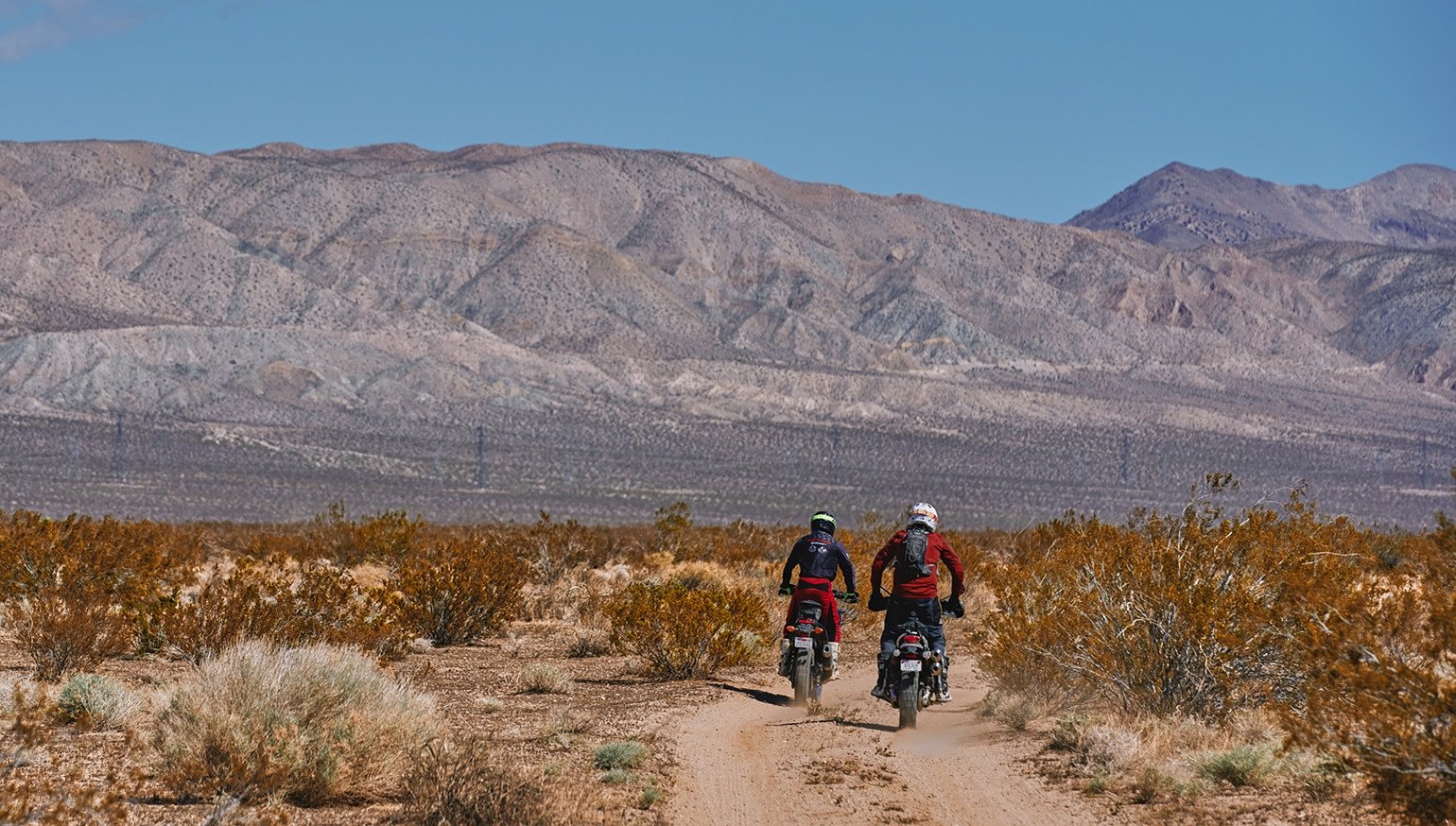
The first 13 miles of my time on the new DR-Z4S jumped from pavement to dirt road, onto single-track, then back to the dirt road and a return to a four-mile jaunt on asphalt again. All in all, 1.6 miles of single-track trail, 6.4 miles of gravel road, and five miles of two-lane blacktop — dual-sporting in a microcosm. There are dozens of motorcycles that could take on that split of riding, and many might be better in certain areas. Suzuki is hoping that by the DR-Z4S being in the middle of the figurative road, it will be the best choice for more actual roads.
2025 Suzuki DR-Z4S
Price (MSRP)
$8,999
Engine
398 cc, liquid-cooled, four-valve, single
Transmission, final drive
Five-speed, chain
Claimed horsepower
38 @ 8,000 rpm
Claimed torque
27.3 foot-pounds @ 6,500 rpm
Frame
Steel twin-spar
Front suspension
KYB 46 mm fork, adjustable for compression and rebound damping; 11.0 inches of travel
Rear suspension
KYB shock, adjustable for spring preload, compression and rebound damping; 11.6 inches of travel
Front brake
Nissin two-piston caliper, 270 mm disc with switchable ABS
Rear brake
Nissin single-piston caliper, 240 mm disc with switchable ABS
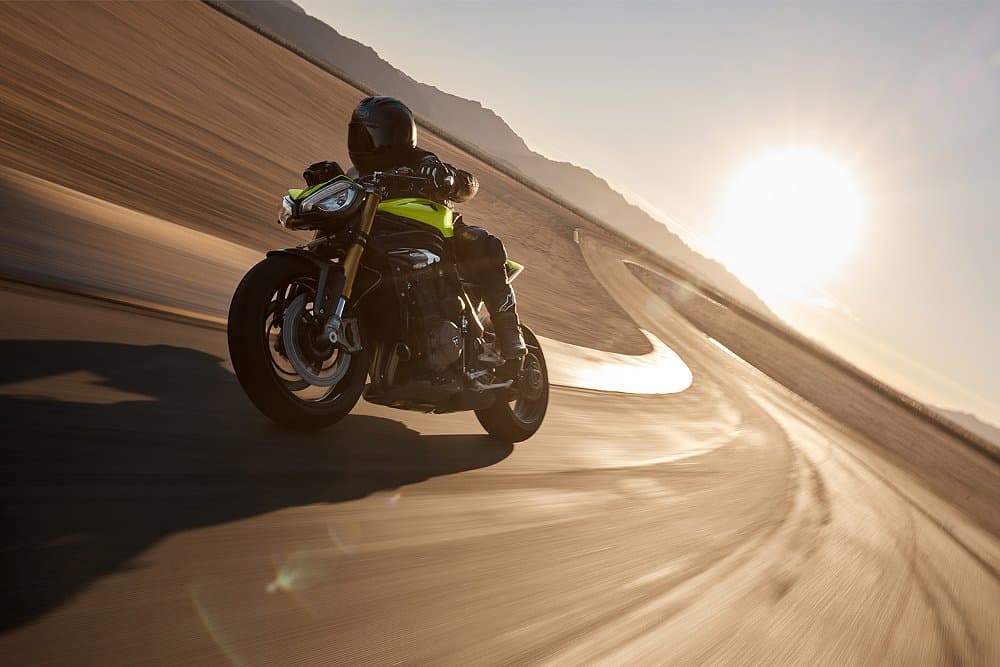
Triumph considers the 2026 Speed Triple 1200 RX the “the ultimate incarnation of the Speed Triple.” There’s a few reasons why.
Compared to the Speed Triple 1200 RS, the RX has “more aggressive, sportier ergonomics” and “even more state-of-the-art electronics.” The limited-edition variant may be the sharpest Speed Triple in the pack, but it follows a formula established by another model in the Triumph’s naked-bike family.
If you catch a slight case of deja vu when viewing the Speed Triple 1200 RX, that’s probably because you’re familiar with the Street Triple 765 Moto2 edition. In essence, the RX is the Speed Triple version of that motorcycle (without all the Moto2 branding, of course). The similarities go deeper than the Performance Yellow paint, too.
The Moto2 has carbon fiber bodywork and exclusive graphics. The RX has carbon fiber bodywork and exclusive graphics. The Moto2 sports clip-ons. The RX sports clip-ons. You get the point. The RX takes similar track-focused measures as the Moto2, but it has a few tricks of its own, too.
That includes a titanium Akrapovič silencer and electronically controlled Öhlins SD EC steering damper. The latter ties directly into the semi-active Öhlins SmartEC3 OBTi system, which debuted on the 2025 Speed Triple 1200 RS.
With its various upgrades, the $21,495 RX tacks $1,500 onto the RS’s $19,995 base price. Triumph will only produce 1,200 units worldwide, with shipments arriving in U.S. dealerships in June.
The 2026 Speed Triple 1200 RX may not be a far departure from its base model sibling, but it’s a viable option for those looking for a part-time track bike.
Flying motorcycles are the stuff of science fiction. That doesn’t mean they’ve stayed that way. In recent years, flying motorcycles are one part sci-fi, one part reality, and all parts absurdity. The Volonaut Airbike is only the latest example.
Created by Polish inventor Tomasz Patan, the Airbike is a VTOL (Vertical Take-off and Landing) vehicle powered by a jet propulsion engine. Per Volonaut, the prototype benefits from a proprietary stabilization system, which unlocks an automatic hover feature and streamlines the controls.
It all sounds highly technical, but don’t expect Volonaut to lift the veil on its technology. Instead of listing specifications, the startup glosses over the specifics. It reports a 124-mph top speed without delving into the mini-turbine engine that achieves that velocity. It claims the prototype is “seven times lighter than a typical motorcycle”
I
Over the last eight years, flying motorcycles have amounted to little more than vaporware. Whatever happened to the Hoversurf S3 that Dubai Police tested, or the “air taxis” Suzuki planned to build? Most recently, Rictor debuted the Skyrider X1 at CES 2025, but only presented images and digital renders of the flying electric motorcycle. With those examples in mind, it’s difficult to see the Airbike reaching mass production. That might be a good thing.
While Volonaut describes the Airbike as a “breakthrough in personal air mobility,” part of me shudders at the thought of flying motorbikes. What happens when you run into a windstorm? What happens when you whiskey throttle into a third-story apartment window? What happens if you run out of fuel?
Don’t get me wrong. Speeder bikes and hover bikes look cool on the silver screen, but that doesn’t mean I want to own one.
BMW completed its 1,300 cc boxer-driven lineup by introducing the 2026 R 1300 RS and R 1300 RT.
Joining the R 1300 GS adventurer and R 1300 R roadster, the tourers bring two flavors of road-oriented travel to the range. The RT sides with a classic touring approach while the RS sprinkles some sporty ingredients into the recipe. The family ties run deep, too, with both models sharing componentry among each other and their other R 1300 relatives.
The same air/liquid-cooled 1,300 cc opposed twin that underlies the GS and R variants returns to power the RS and RT. BMW still lists the ShiftCam-equipped mill at 145 horsepower (at 7,750 rpm) and 110 foot-pounds of torque (at 6,500 rpm), which accounts for a nine-horsepower and five-foot-pound increase over the outgoing R 1250 models. Like all R 1300s, the RS and RT shoehorn that big boxer into a steel sheet metal frame. From there, the two models take their separate paths.
The RS sticks to the trail blazed by the R 1300 R. That means a 47 mm inverted fork and BMW’s EVO Paralever II suspend the sport-tourer, retaining the same wheel travel (5.5 inches fore and 5.1 inches aft) as its fairing-less sibling. It doesn’t follow in every footstep, though, as the RS’s 28-degree rake helps extend the wheelbase (60.0 inches) to suit long-distance journeys. What wasn’t changed to serve pavement-pounding ventures is the 4.5-gallon tank retained from the R model.
By contrast, the RT shares some qualities with the GS, but street-focused changes give it an identity all its own. For instance, BMW’s front EVO Telelever and rear EVO Paralever return on the RT, but wheel travel shrinks to 5.9 inches and 6.2 inches, respectively. The 17-inch wheelset caters to the model’s road bias while the 6.3-gallon tank extends the periods between fill-ups.
The Munich manufacturer almost always showcases its top-of-the-line trims. For proof, look no further than the promo videos for the R 1300 RS (above) and R 1300 RT (below). Both flaunt the premium-spec version of each model. That can be somewhat misleading, especially when the brand only announces the bike’s starting price.
BMW lists the base model R 1300 RS at $16,995. Good luck getting it anywhere near that price, though. When configuring the bike on BMW’s website, the Racer Blue Package comes out to $22,560 while the Triple Black Package bumps the total up to $23,370. Here’s the kicker. Those are the most affordable options. Outfitted in the Performance Package, the RS sells for $24,560. The Option 719 trim only goes one step further, pushing the price to $24,845. That’s a $7,850 markup. In other words, 46% of the model’s starting price.
It’s a similar story with the R 1300 RT. The costs of the Alpine White ($30,535), Triple Black ($32,575), Impulse ($33,225), and Option 719 ($36,320) Packages all dwarf the tourer’s $22,495 starting price. It’s worth noting that most (if not all) U.S.-bound RSs and RTs will arrive with one of BMW’s accessory packages. Customers can expect those units to appear in dealership showrooms by Q3 or Q4 of 2025.
BMW EVO Paralever, electronically adjustable for spring preload and rebound damping; 6.2 inches of travel
Front brake
Dual four-piston radial calipers, 310 mm discs with ABS
Rear brake
Two-piston floating caliper, 285 mm disc with ABS
Rake, trail
28.0 degrees, 4.8 inches
26/0 degrees, 4.5 inches
Wheelbase
60.0 inches
59.0 inches
Seat height
31.1 / 33.3 inches
30.7 / 33.9 inches
Fuel capacity
4.5 gallons
6.3 gallons
Tires
120/70 ZR17 front, 180/55ZR17 rear
Claimed weight
540 pounds
620 pounds
Available
Q3/Q4 2025
Warranty
36 months / 36,000 miles
More info
bmwmotorcycles.com
Happy
00 %
Sad
00 %
Excited
00 %
Sleepy
00 %
Angry
00 %
Surprise
00 %
We use cookies on our website to give you the most relevant experience by remembering your preferences and repeat visits. By clicking “Accept”, you consent to the use of ALL the cookies.
This website uses cookies to improve your experience while you navigate through the website. Out of these, the cookies that are categorized as necessary are stored on your browser as they are essential for the working of basic functionalities of the website. We also use third-party cookies that help us analyze and understand how you use this website. These cookies will be stored in your browser only with your consent. You also have the option to opt-out of these cookies. But opting out of some of these cookies may affect your browsing experience.
Necessary cookies are absolutely essential for the website to function properly. These cookies ensure basic functionalities and security features of the website, anonymously.
Cookie
Duration
Description
cookielawinfo-checbox-analytics
11 months
This cookie is set by GDPR Cookie Consent plugin. The cookie is used to store the user consent for the cookies in the category "Analytics".
cookielawinfo-checbox-functional
11 months
The cookie is set by GDPR cookie consent to record the user consent for the cookies in the category "Functional".
cookielawinfo-checbox-others
11 months
This cookie is set by GDPR Cookie Consent plugin. The cookie is used to store the user consent for the cookies in the category "Other.
cookielawinfo-checkbox-necessary
11 months
This cookie is set by GDPR Cookie Consent plugin. The cookies is used to store the user consent for the cookies in the category "Necessary".
cookielawinfo-checkbox-performance
11 months
This cookie is set by GDPR Cookie Consent plugin. The cookie is used to store the user consent for the cookies in the category "Performance".
viewed_cookie_policy
11 months
The cookie is set by the GDPR Cookie Consent plugin and is used to store whether or not user has consented to the use of cookies. It does not store any personal data.
Functional cookies help to perform certain functionalities like sharing the content of the website on social media platforms, collect feedbacks, and other third-party features.
Performance cookies are used to understand and analyze the key performance indexes of the website which helps in delivering a better user experience for the visitors.
Analytical cookies are used to understand how visitors interact with the website. These cookies help provide information on metrics the number of visitors, bounce rate, traffic source, etc.
Advertisement cookies are used to provide visitors with relevant ads and marketing campaigns. These cookies track visitors across websites and collect information to provide customized ads.