
When Suzuki’s DR-Z400S landed in showrooms 25 years ago, motorcycling was different. Fuel injection and anti-lock brakes were still only trickling in. The machine that won the World Superbike Championship made 120 horsepower in stock trim, and two-stroke machines left a haze of blue smoke in AMA Supercross arenas.

To be a valid dual-sport machine in the year 2000, a bike needed to be able to travel highway speeds and trot down a bumpy trail. A quarter century later, the on- and off-road space is crowded — from the handful of 300 to 500 cc ADV machines available to the hordes of gnarly off-road machines with towering seats and zero body fat — and many of the bases, or roads, are covered. This is the new school of multi-surface riding and, in order for the DR-Z to fit in, a makeover was in order.
The new DR-Z by the numbers
As far as the spec sheet goes, some things have changed and some things have stayed the same. A removeable, aluminum subframe carries all of the stuff at the stern, perched above a new swingarm.
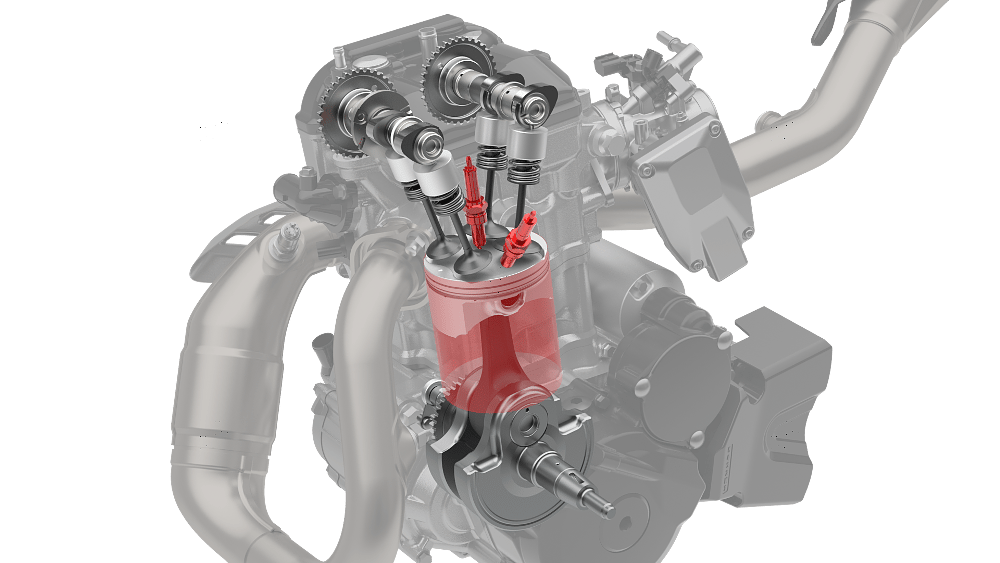
The engine itself has new valves, slightly more aggressive cam profiles, a dual-spark combustion chamber, and a new piston design, all of which is fed by a fuel-injection system via a larger throttle body and ride-by-wire right grip. That technology allowed Suzuki to make available three ride modes, three levels of traction control (plus off), and customizable ABS settings.
To pull the DR-Z out of the dark ages of Euro2 emissions compliance, the new bike predictably has an all-new exhaust system, with two catalytic converters integrated in order to meet Euro5+ standards. Because the outgoing DR-Z400 is a 25-year-old design, Suzuki had to reduce carbon monoxide emissions by 82% and total hydrocarbons by 90%. Big changes and, based on the expressions on the engineers’ faces as they explained it, a little bit of a pain to achieve.

All of this cost Suzuki some weight the fuel-injection upgrade amounted to more than 16 pounds and introducing ABS added about five pounds. Some of the weight gain was offset elsewhere, but it was a battle that involved a lot of one-step-forward, two-steps-back compromises.
All of the updates to the engine and powertrain highlight the broader dichotomy of updating the DR-Z. Part of the task was to make somewhat generic and obvious updates, like adding EFI and spicier cams, but at the same time it was crucial that everything worked together a lot more efficiently than before. Using titanium intake valves and reducing pumping losses in the crankcase by 20% sounds pretty racy until you realize that it’s all just to stay afloat.
Some good news is that the chassis updates thoroughly modernized the DR-Z with little to no downsides. There’s new suspension from KYB (fully adjustable aside from front-spring preload), a stiffer swingarm with a new shock linkage for more linear spring resistance, larger brake rotors front and rear, not to mention LED lighting. Also, some tweaked ergonomics the handlebar is 1.1 inches higher, the footpegs sit 0.9 inches farther back, and the seat has been made wider and lower by 0.6 inches each.
What’s a little different from most on/off-road bikes these days is the dash and switchgear. The two-color LCD display is humble, but packs a lot of info, and mates with a left control cluster featuring an up/down toggle and a “Mode” button. Street bike stuff.
There’s no denying that $9,000 is a lot to ask for a revamped dual-sport from 25 years ago. On the other hand, a quick look at the market shows a pretty big hole where the DR-Z4S is aimed. A buyer can get dual-sport bikes from Honda and Kawasaki for around $5,500, with lower seat heights, less suspension travel, smaller engines, and less advanced rider aids. You could also buy a KTM 390 Enduro R for the same price, and that might be a good option though it is a street bike dressed up as a dirt bike.
Or, there’s Honda’s CRF450RL, which only costs about $1,000 more than a DR-Z4S while having much more power and a serious off-road chassis. Then again, you’ll have to be ready to change the oil every 600 miles, climb up to a 37.2-inch seat, and don’t you dare let those revs drop or it’ll…! Crap, it stalled again. There’s always the Jurassic duo of Honda’s XR650L and Suzuki’s own DR650, for those who simply wish that things would never change.

The DR-Z4S calls for new engine oil every 3,750 miles and a check of valve clearances every 15,000 miles. It’ll also do third-gear wheelies on a gravel road, hop down a narrow trail or across a stream, and accommodate just about any rider’s desired delivery of 38 horsepower. Is all of that worth nine grand? From Suzuki’s standpoint, that hole in the market is either there for a reason, or it’s an opportunity to deliver.
The first 13 miles of my time on the new DR-Z4S jumped from pavement to dirt road, onto single-track, then back to the dirt road and a return to a four-mile jaunt on asphalt again. All in all, 1.6 miles of single-track trail, 6.4 miles of gravel road, and five miles of two-lane blacktop — dual-sporting in a microcosm. There are dozens of motorcycles that could take on that split of riding, and many might be better in certain areas. Suzuki is hoping that by the DR-Z4S being in the middle of the figurative road, it will be the best choice for more actual roads.
| 2025 Suzuki DR-Z4S | |
|---|---|
| Price (MSRP) | $8,999 |
| Engine | 398 cc, liquid-cooled, four-valve, single |
| Transmission, final drive | Five-speed, chain |
| Claimed horsepower | 38 @ 8,000 rpm |
| Claimed torque | 27.3 foot-pounds @ 6,500 rpm |
| Frame | Steel twin-spar |
| Front suspension | KYB 46 mm fork, adjustable for compression and rebound damping; 11.0 inches of travel |
| Rear suspension | KYB shock, adjustable for spring preload, compression and rebound damping; 11.6 inches of travel |
| Front brake | Nissin two-piston caliper, 270 mm disc with switchable ABS |
| Rear brake | Nissin single-piston caliper, 240 mm disc with switchable ABS |
| Rake, trail | 27.5 degrees, 4.3 inches |
| Wheelbase | 58.6 inches |
| Seat height | 36.2 inches |
| Fuel capacity | 2.3 gallons |
| Tires | IRC Trail Winner GP-410, 80/100-21 front, 120/80-18 rear |
| Claimed weight | 333 pounds |
| Available | Now |
| Warranty | 12 months, unlimited miles |


