Are motorcycle electronics a dangerous distraction?

Read Time:4 Minute, 33 Second

A top-down shot of the BMW R 1300 RT's 10.25-inch TFT display.

Yes, safety and convenience are good things. But like anything, too much of a good thing can also be a bad thing. As OEMs cram more and more technology into today’s motorcycles, it seems like things are trending that way.

TFT (thin-film transistor) displays have become standard equipment over the past decade. Even beginner bikes like KTM’s 390 Duke and Kawasaki’s Z500 SE now come outfitted with full-color dashes. TFTs aren’t just ubiquitous, though. They’re also bigger.

A view of the KTM's new V80 display from the 1390 Super Adventure R's cockpit.

In October, KTM introduced a new eight-inch vertical display. As large as that sounds, BMW’s 10.25-inch unit found on select R 1300, R 18, and K 1600 models dwarfs all competition. Now more than ever, that extra screen space makes room for GPS navigation, music playback, or incoming messages and calls. Each feature may present a convenient new tool to the rider, but at the same time, they also present a new distraction.

Even if you forego all of today’s digital luxuries (like I often do), it doesn’t mean your ride is free of distractions. At least, that’s what I learned when testing Ducati’s XDiavel V4. Like the Panigale V4 superbike, Ducati’s muscle cruiser now sports a 6.9-inch TFT display. It’s glare-resistant, thanks to Optical Bonding technology. It’s panoramic, with an 8:3 aspect ratio. In short, the XDiavel’s dash commands attention. Maybe a little too much attention at times.

A close-up of the Ducati XDiavel V4's 6.9-inch TFT display.

Aside from displaying secondary readouts like trip meters, range, and engine temperature, the XDiavel’s screen also relays less critical data, such as torque and power output. There’s even a G-force meter. It’s those settings that often drew my attention away from the road at the worst time possible.

Power and torque values reach their peak under heavy acceleration. The highest G-force measurements occur while cornering. Both scenarios require the rider’s full concentration. Yet, the performance metrics often lured my eyes away from the task at hand. I couldn’t help but wonder how many Gs I was pulling or how much power I was using. My curiosity (and my ego) often got the best of me. It’s an unintended byproduct of the XDiavel’s top-of-the-line electronics suite. That’s not always the case, though. Some quirks are by design.

A close-up of the Honda Gold Wing's dash and tank console.

Large, colorful TFTs aren’t the only distractions riders contend with. The controls that operate those big, beautiful screens can interfere with the riding experience, as well. My time spent aboard the 2025 Z900 SE illustrates that point best.

There are two rocker switches at Z’s left hand grip. Kawasaki stamps both with a Mode label. That’s why I assumed tapping each button would shuffle through the model’s ride modes. Well, you know what they say about assuming. Instead, the top button changed the dash’s lower left readout while the bottom button cycled the lower right readout. Makes sense (he said sarcastically). 

A close-up of the Kawasaki Z900 SE's left switchcube.

When it comes to safety, proper button functionality is key. That much is evident. But the sheer number of buttons on modern motorcycles can be just as disruptive. Practically all new bikes come with a smartphone pairing technology that mirrors directions and music playback onto the motorcycle’s dash. Such features are often a source of distraction. That goes beyond the image on the screen, too.

I’ve already aired my frustrations with the Honda NT1100’s Apple CarPlay and the Yamaha MT-09’s Y-Connect. But, here’s the thing, no matter how functional (or dysfunctional) an infotainment system is, it isn’t mission critical. If it doesn’t connect, or if you bypass altogether, it’s out of your way. Finito. End of conversation. The same can’t be said for the buttons that come along with such systems.
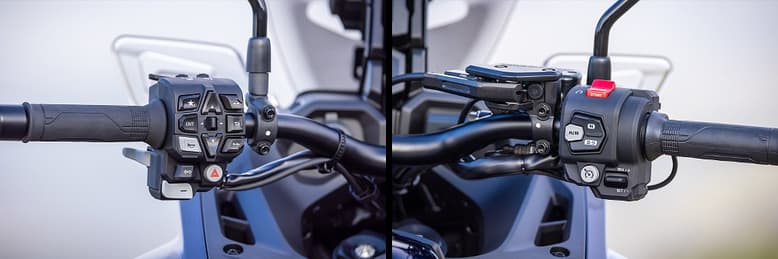
A split shot of the Honda NT1100 DCT's left and right handgrips.

If crowded controls were a crime, the NT1100 DCT would be guilty on several counts. With nearly 25 buttons split between its two switchcubes, there’s no shortage of options at the rider’s fingertips. On the other hand, the NT’s jumbled layout also proved problematic. Even after familiarizing myself with the sport-tourer over two days, even after racking up 315 miles in its saddle, I still found myself looking away from the road to make on-the-go adjustments. I doubt Honda foresaw that outcome when it configured the NT’s controls. One solution to that problem is return to simplicity.

Simple can be harder than complex

Sometimes, more is less. That’s especially true when you’ve reached the complexity level of modern motorcycles. It’s also a build mantra that manufacturers can adopt for future lineups. In fact, Yamaha already did as much with the Tracer 9.

The 2025 Yamaha Tracer 9 pictured against a mountain.

For years, the crossover tourer was the recipient of Team Blue’s latest innovations. The 2021 Tracer 9 GT arrived with electronically controlled suspension, IMU-informed rider aids, and a dual-pane TFT dash. By 2024, the Tracer 9 GT+ gained radar-assisted adaptive cruise control and emergency braking system. None of those upgrades resonated with customers, unfortunately, forcing Yamaha to return to the base model Tracer 9 in 2025.

A close-up of the Yamaha Tracer 9 GT's dual-panel display.

Technology enhances the safety and convenience of modern motorcycles. That’s indisputable. At the same time, if technology becomes a distraction, those end goals are quickly compromised. Motorcycle electronics have come a long way over the past decade. What do you think ?

Happy
Happy
0 %
Sad
Sad
0 %
Excited
Excited
0 %
Sleepy
Sleepy
0 %
Angry
Angry
0 %
Surprise
Surprise
0 %

2026 Triumph TF 250-X First Look

Read Time:2 Minute, 15 Second

Triumph’s TF 250-X was immediately competitive when it debuted for the 2024 model year, but that hasn’t stopped the British brand from continuing to tweak its motocross bike. For 2025, Triumph updated the ECU mapping for more consistent fueling and power delivery, and now, for the 2026 model year, the TF 250-X gets an even more significant update, with a new airbox, exhaust, and clutch, plus new suspension settings.

“The TF 250-X has already made a huge impact in the motocross world, delivering podium-finish performances in the 2025 AMA Supercross Championship, as well as the MX2 class in MXGP,” says Steve Sargent, Triumph’s Chief Product Officer. “This TF 250-X, built for 2026, is the result of relentless development and feedback from our factory riders. With sharper power delivery, refined suspension, and advanced electronics, it’s built to give riders the edge they need to win.”

2026 triumph tf 250 x first look

Triumph designed a new airbox and updated the silencer to optimize airflow. The engine mapping was updated accordingly for quicker launches and sharper corner exits. Triumph says the updates improve power delivery and throttle response, while still complying with the new FIM and AMA sound restrictions.

For 2026, the TF 250-X receives a new Exedy clutch that Triumph claims to offer more direct engagement and increased torque capacity, while also being more durable under extreme use compared to the previous design.

The KYB suspension has also been updated with improved mid-stroke control, a change Triumph claims to provides better stability through corners and improves overall chassis balance.

For easier servicing, Triumph updated the battery tray for better accessibility, while designing a more accurate oil level sight glass.

And of course, there’s a new graphics package for 2026, with Triumph Performance Yellow in-mould decals over Jet Black and Pure White.

Pricing has not been announced, though we can expect it to come when the 2026 Triumph TF 250-X will arrive in dealerships this summer.

2026 Triumph TF 250-X Specifications
Engine TypeSingle Cylinder 4-Stroke DOHC
Capacity249.95 cc
Bore x Stroke78.0 mm x 52.3 mm
Compression14.4
SystemDell’Orto EFI
ExhaustSingle Silencer
Final Drive13/48
ClutchWet Multi-Plate Belleville Spring
Gearbox5 Speed
FrameAluminum, Spine
SwingarmAluminum Fabrication
Front Wheel21″ x 1.6″
Rear Wheel19″ x 1.85″
Front Tire80/100 – 21
Rear Tire100/90 – 19
Front Suspension48mm KYB coil spring fork, compression/rebound adjustment, 12.2 inches of travel
Rear SuspensionKYB Coil, compression adjustment (H and L speed), rebound adjustment, 12.0 inches of travel
Front BrakesBrembo Twin 24mm Piston, 260mm Disc
Rear BrakesBrembo single 26mm piston, 220mm disc
Instrument Display / FunctionsHour Meter, Multifunction Switch Cubes
Width Handlebars32.91 inches
Height Without Mirror50 inches
Seat Height37.8 inches
Wheelbase58.74 inches
Rake / Trail27.4° / 4.57 inches
Wet Weight229.3 pounds (claimed)
Tank Capacity1.85 gallons
Happy
Happy
0 %
Sad
Sad
0 %
Excited
Excited
0 %
Sleepy
Sleepy
0 %
Angry
Angry
0 %
Surprise
Surprise
0 %

Legendary biker destination Sturgis Buffalo Chip Heads to Southern Nevada with New Casino Hotel

Read Time:3 Minute, 14 Second
sturgis buffalo chip heads to vegas with new casino hotel

Mark Advent and Rod “Woody” Woodruff Join Forces to Create Unforgettable Experiences Across the U.S. and Beyond

The Sturgis Buffalo Chip, famed as the “Best Party Anywhere” for the nicest people on the planet, is revving up for an exhilarating new chapter that will spread its authentic spirit to exciting new locations throughout the U.S. and beyond. Today, the visionary developer Mark Advent, founder of Advent Creations and the mastermind behind Las Vegas’ iconic “New York New York” hotel and casino, announces a landmark partnership with Sturgis Buffalo Chip, launching an ambitious journey to take this renowned entertainment and lifestyle institution on the road.

At the heart of this expansion is the innovative Buffalo Chip casino hotel, a one-of-a-kind entertainment destination that’s set to redefine fun, recreation, and lifestyle. Projected to debut in Southern Nevada, this one-of-a-kind resort will feature a barn-themed casino, a high-end 200-room hotel, and a vibrant pedestrian thoroughfare dubbed Sturgis Street, lined with specialty retail shops, down-home dining, and wholesome entertainment.

Highlighting this experience will be Woody’s Barn, an epic live event venue; the Honky Tonk, a three-level music bar; a 10,000-seat amphitheater; Tiny Town’s collection of tiny homes; and Bikini Beach, the Chip’s ultimate summer oasis for sun and fun-seekers. With RV parking, a mini gas station and general store, and a replica of the over-the-top Big Engine Bar, this destination will be a tribute to the American spirit and the fusion of originality and Americana at its best.

Rod “Woody” Woodruff, who founded the Sturgis Buffalo Chip in 1981, has dedicated over four decades to crafting what is now a beloved American entertainment and lifestyle beacon. Conceived initially as a campground for riders attending the annual Sturgis Motorcycle Rally, the Chip has transformed into a vibrant town fueled by roaring engines, chart-topping rock, and an unwavering sense of community. With unforgettable performances from rock stars like Kid Rock, ZZ Top, Alice Cooper, Aerosmith, Mötley Crüe, and Def Leppard, the Chip has become a storied locale where memories of good times are born.

“Starting the Chip was about creating a home for people who live for the ride,” said Rod “Woody” Woodruff. “Now, with Mark and his team, we’re turning that spirit into a year-round experience that resonates in even more places.”

“It’s an honor to join forces with Woody and his family,” stated Mark Advent. “The Chip isn’t just a place – it’s an unparalleled feeling. It embodies music, motorcycles, freedom, and friends, each representing one of the four pillars on which the Chip is deeply rooted. We’re developing new destinations that will capture the same feeling of freedom and camaraderie that has been enjoyed by millions of people over the years. In doing so, we will introduce the “Best Party Anywhere” to even more people!”

In addition to the flagship casino hotel, this partnership introduces the Sturgis Buffalo Chip Roadhouse – a spirited collection of restaurants and bars designed to bring the same ethos, character, and energy to towns and cities across America. “For our guests, the Chip embodies tradition,” noted Daymon Woodruff, President of the Buffalo Chip. “It’s a reunion, a pilgrimage, a celebration of individuality. Now, we get to bottle that magic and share it with even more people in more pioneering ways than ever.”

The Chip’s passion and excellence of service forge lifelong friendships and lasting memories in a safe and inviting atmosphere of freedom. The momentum is electric, and the vision is audacious. Together, Advent and the Buffalo Chip team are crafting something unprecedented: a lifestyle-driven destination brand rooted in unapologetic fun and American originality. From the original rally grounds on the Black Hills of South Dakota to the neon-lit deserts of Nevada, the Buffalo Chip is in the saddle and ready to ride.

Happy
Happy
0 %
Sad
Sad
0 %
Excited
Excited
0 %
Sleepy
Sleepy
0 %
Angry
Angry
0 %
Surprise
Surprise
0 %


More small, affordable motorcycles to hit the U.S. market in 2026

Read Time:2 Minute, 14 Second

The Kawasaki KLX230 DF and KLX230 Sherpa S staged wheel to wheel against a white background.

Kawasaki introduced the KLX230 in 2020. It not only arrived as a lightweight, userfriendly offering, it also sided with simplicity, featuring an air-cooled, fuel-injected 233 cc single and minimal electronics. The model’s $4,599 ($4,899 with ABS) MSRP was a big draw, too. For 2026, the KLX230 will return (now $4,999 non-ABS, $5,299 ABS) with two new variants in tow. 

Kawi positions the KLX230 Sherpa S as its “rugged, yet approachable, package designed for the modern-day trekker.” A lower seat height of 32.5 inches (versus the base model’s 33.3-inch seat height) and tubeless rear wheel account for much of the Sherpa’s added approachability. 

A KLX230 Sherpa S rider riders through an urban landscape.

The KLX230 DF, on the other hand, is prepped for off-road exploration. At least that’s what the model’s long-travel suspension, engine guards, and tail rack suggest. 

A split shot of the KLX230 DF's rear luggage rack and lower engine guard.

The Sherpa and DF are just the latest low-capacity air-cooled models to hit the market. Mainstays like Yamaha’s TW200 and XT250 are still around, but Honda wears the crown in this category. While its miniMOTO range is the primary reason, Big Red isn’t putting all of its eggs in one basket.

A rider stands next to the Kawasaki W230 retro roadster with a beach in the background.

The XR150L found success in Asia, Australia, and New Zealand before Honda sent the model Stateside in 2023. Built by Sundiro Honda, a subsidiary of the Japanese marque, the diminutive dual-sport houses an air-cooled 149.2 cc single that’s fueled by a Keihin carburetor. Talk about simple. The model’s $3,299 price tag says as much, too. The XR isn’t just an outlier in American Honda’s lineup, though. It might just be a sign of more things to come from the brand.

A close up of the Honda XR150L's analog dash.

In May, Honda pulled the covers off the CRF300F at the Festival Interlagos in São Paulo, Brazil. The trail bike will harness the same air-cooled 293 cc one-pot mill that already powers several models in Brazil, including the CRF300F Twister, XR300L Tornado, and Sahara 300. Recent California Air Resources Board (CARB) documents indicate that Honda intends to send the CRF to the States as a 2026 model. If that comes true, the U.S. market could welcome yet another price-conscious, bare-bones option in the months to come.

The United States is still a destination for premium motorcycles. That won’t change anytime soon. What is changing is how many low-tech, low-cost models are arriving on U.S. shores. With the first tariff-related price increases arriving and more on the horizon budget-friendly motorcycles are more relevant than ever. It seems, not everything is bigger in America.

Leave us your comments.

Happy
Happy
0 %
Sad
Sad
0 %
Excited
Excited
0 %
Sleepy
Sleepy
0 %
Angry
Angry
0 %
Surprise
Surprise
0 %
Read Time:5 Minute, 41 Second

2025 Honda CB1000 Hornet SP

front view of a rider on the Hornet on a curving road

U.S. riders will be less familiar with the Hornet name than the rest of the world, in part for legal reasons and in part because this is not the first time Honda made us wait. The first Hornet was a Japan-only CB250 model that came out in 1996. The CB600F Hornet and CB900F Hornet came out in 1998 and 2002 in other markets, and while the we got the 900 right away, the 600 didn’t arrive until 2004. Having trouble remembering a Hornet model from those years? That’s because they were called the 599 and 919, because Chrysler owned rights to the Hornet name in the United States. This time around, Honda was able to negotiate use of the Hornet name. Part of that deal was letting Ram use the Rebel name on one of its pickup trucks.

The Hornet name implies a certain formula: a naked bike with broad-shouldered, narrow-waisted look that features a punchy engine, agile handling, and an attractive price. The current generation of Hornets is not as unadorned as the 599 and 919 of 20 years ago, but they carry on the same theme.

illustration showing the shape of the Hornet from overhead

The arrival of the CB1000 Hornet SP does not quite bring us to parity with European consumers, because the U.S. market only gets the SP version, not the base CB1000 model available elsewhere. But considering the SP’s price, that’s not such a deprivation.

The SP comes with upgraded suspension in the form of a fully adjustable Öhlins TTX36 shock on the rear and a 41 mm inverted Showa Separate Function Fork Big Piston (SFF-BP) in front, both offering more than five inches of travel. Brakes are also upgraded with Brembo Stylema radial-mount four-piston calipers in front and a Nissin caliper on the back wheel.

Hornets were traditionally four-cylinder models, and while that’s no longer true with the new CB750, the CB1000 carries a classic, Japanese, inline-four engine in its steel, twin-spar frame. The engine is derived from the one that dates back to the 2017 CBR1000RR. American Honda does not typically announce power output. In Europe, the SP makes a claimed 155 horsepower, but reports here, based on regulatory documents, have speculated the U.S. model will be about 25 horsepower weaker. We won’t know the real number for sure until we see some dyno tests. Honda says differences between its European and U.S. models are due to the fact that the European standards are stricter on emissions while the U.S. standards are tighter on sound.

The Hornet comes with three preset ride modes, Standard, Sport, and Rain. The rider can set two additional customized ride modes. Three parameters change based on the ride mode: three levels of power delivery, traction control, and engine braking. For example, Standard chooses the middle level of all three parameters. Sport chooses the lower levels of traction control and engine braking and the most aggressive level of power delivery. The three “Power” settings do not change the level of maximum power, but rather the way it’s delivered, from a softer to a more abrupt response. In the two user modes, traction control can be turned off, but there’s a catch for your own safety, apparently that you would-be hooligans or track-day riders out there need to know. Say you set User 1 to the most aggressive power delivery, the lowest level of engine braking, and with traction control off. Each time the motorcycle is powered off, the user mode will reset to traction control on, but at the lowest setting, while the other settings remain the as you set them. In other words, you’ll have to go into the menu and turn off traction control every time you turn on the key, if you want to ride without the safety net.

The SP also comes stock with a quickshifter that can be adjusted to three settings independently for upshifts and downshifts.

view of digital display

All the information is displayed on a five-inch TFT dash that can be set to three different layouts and your choice of a light or dark background. The Hornet also comes with Honda’s RoadSync, which allows you to connect your phone to the bike for calls, music, voice directions, etc. I didn’t have a comm unit in the new helmet I took on this ride, so I wasn’t able to test the voice connections. 

Riding the 2025 Honda CB1000 Hornet SP

While the Hornet’s bare-naked styling and upright ergonomics provide no wind protection, that does mean I had undisturbed air flow over my helmet with no buffeting. That, along with the lack of vibration from the inline-four engine (Honda also uses rubber mounts where the engine bolts to the frame at the rear) made for a smooth ride on the freeway. Honda also made sixth gear significantly taller for lower engine speeds when just cruising down the highway.

front view showing the rectangular digital display sticking up above the headlights

The slipper clutch is not as light as the CB750’s but the pull is not particularly heavy, either, and since the quickshifter on the SP works well, there’s no frequent need to use the clutch lever.

rider on the CB1000 SP Hornet on a curving road with a lake in the background

The power delivery, like the quickshifter sensitivity, is really just a matter of personal preference. The “3” setting on power gives the same total power as “2,” but the middle setting makes it easier for me to be smooth with the throttle, so I’d probably leave it there forever, except when using Rain mode. The good thing about the adjustability is you can choose what feels right to you. Whichever you choose, throttle response is refreshingly free of the undue abruptness that afflicts many other models these days.

The Brembo brakes up front provided a little less initial bite than I expected but were everything I’d ever need for street riding, for sure. Honda says the CB1000 SP weighs 465 pounds full of fuel and ready to ride, and that weight, quite competitive for its class, reduces demands on brakes and suspension.

rear three-quarters view of the Hornet showing the prominent rear arm extending out to hold the tail light and turn signals

Give the CB1000 Hornet SP a look.

2025 Honda CB1000 Hornet SP
Price (MSRP)$10,999
Engine1,000 cc, liquid-cooled, 16-valve, inline four-cylinder
Transmission,
final drive
Six-speed, chain
Claimed horsepowerN/A
Claimed torqueN/A
FrameSteel twin-spar
Front suspension41 mm Showa Separate Function Fork Big Piston (SFF-BP), adjustable for preload, compression, and rebound damping; 5.1 inches of travel
Rear suspensionÖhlins TTX36 shock, adjustable for preload, compression, and rebound damping; 5.5 inches of travel
Front brakeDual Brembo Stylema radial-mount four-piston calipers, 310 mm discs, with ABS
Rear brakeSingle Nissin one-piston caliper, 240 mm disc, with ABS
Rake, trail25 degrees, 3.9 inches
Wheelbase57.3 inches
Seat height31.9 inches
Fuel capacity4.5 gallons
TiresMichelin Road 6*, 120/70R17 front, 180/55R17 rear
(* – as tested; some will come with Dunlop Roadsport 2 tires)
Claimed weight465 pounds wet
AvailableNow
Warranty12 months
Happy
Happy
0 %
Sad
Sad
0 %
Excited
Excited
0 %
Sleepy
Sleepy
0 %
Angry
Angry
0 %
Surprise
Surprise
0 %