Motorcycles targeted by new “derivative” steel and aluminum tariffs

Read Time:3 Minute, 13 Second

President Trump expanded the breadth of his existing aluminum and steel tariffs to include additional “derivative” products. The list contained 407 new product categories, including motorcycles. 

Under the directive, foreign-produced steel and aluminum contained within each motorbike imported into the United States is now subject to a 50% tax. The previously imposed country-based “reciprocal tariffs” still apply to the bike’s non-steel/aluminum components, but it’s unclear whether the metals incur dual duties or not. That’s not the only detail driving confusion around the tariffs.

A loaded cargo ship enters the port of Los Angeles in Long Beach, California.

The updated product list, posted to the Federal Register on Tuesday, doesn’t mention motorcycles by name. Instead, it includes several Harmonized Tariff Schedule of the United States (HTSUS) codes for motorcycles, all of which start with 8711. Not all codes and categories are included, however. While motorcycles between 250 cc and 500 cc (8711.30), those exceeding 800 cc (8711.50), and electric-driven models (8711.60) make the list, bikes under 50 cc (8711.10), between 50 cc and 250 cc (8711.20), and between 500 cc and 800 cc (8711.40) are missing. Entries within those segments are just as likely to contain steel and aluminum, so there’s no obvious explanation for the omission of those codes.

Another facet of the tariffs that concern freight shipper and manufacturers is its expedited implementation. Announced by the Customs and Border Protection agency on Friday evening (7:26 p.m. EDT, to be exact), the new trade policy went into effect on Monday, meaning all goods currently in transit now fall under the broadened guidelines.

Past is prologue

In 2018, the first Trump administration established a 25% tariff on steel imports and a 10% tariff on aluminum imports. Those tariffs later expanded to include specific derivative products in 2020. Those rates were maintained during Joe Biden’s presidency, but U.S. allies like Canada, Mexico, Japan, and South Korea received exemptions. 

Two production-line employees converse at Harley-Davidson's York, Pennsylvania plant.

In March of this year, Trump not only cancelled those exemptions but also raised aluminum duties to 25%. By June, the tariff rates surged to 50%. Friday’s announcement is just the latest escalation, which seeks to eliminate what the administration calls “duty evasion schemes.”

“Today’s action expands the reach of the steel and aluminum tariffs and shuts down avenues for circumvention,” said U.S. Secretary of Commerce for Industry and Security Jeffrey Kessler, “supporting the continued revitalization of the American steel and aluminum industries.”

A fork lift carries a shipping container through a container yard.

The goal of Trump’s policies is to boost U.S. companies and support opportunities for workers, but an International Trade Commission study conducted in 2023 found that the 2018 metals duties only marginally improved steel and aluminum production in the States; all while increasing the costs of automobiles, machines, and tools in the process.

Barriers to entry

The tariff expansion arrives as shipments to the United States continue to slow. Japan, for instance, reduced its exports to the country by 11.4% in June and 10.1% in July (the government data doesn’t specify whether Honda, Kawasaki, Suzuki, or Yamaha are included). The addition of derivative product duties don’t bode well for trade, either, according to the Motorcycle Industry Council (MIC), which opposed the tariffs on derivative products. The MIC expressed concern that some companies in the motorcycle industry would take a financial hit and that some products could no longer be available in the U.S. market.

A motorcycle rider guides the Yamaha XSR700 past shipping containers in a container yard.

“Despite our opposition to these new tariffs and our request to be excluded from them, the Department of Commerce decided to move forward with tariffs that broaden the range of products now covered under Section 232,” said MIC Senior Vice President of Government Relations Scott Schloegel. “As a nearly $51 billion industry, we will continue to engage with the administration and policymakers to push for balanced trade rules that don’t cripple our industry.”

Happy
Happy
0 %
Sad
Sad
100 %
Excited
Excited
0 %
Sleepy
Sleepy
0 %
Angry
Angry
0 %
Surprise
Surprise
0 %
Read Time:1 Minute, 43 Second

Harley-Davidson names new CEO

After more than five years of being led by a CEO who made his name by turning around an athletic shoe company, Harley-Davidson will now be led by an executive whose background is golf-based entertainment centers and pizza.

Harley-Davidson announced today that Artie Starrs will replace Jochen Zeitz as CEO. Starrs comes to Harley-Davidson from his post as CEO of Topgolf International. Topgolf is a chain of sports entertainment franchises that combine aspects of the traditional golf practice range with food, drink, and games. The Harley-Davidson press release notes that Topgolf expanded into five additional countries and grew its revenues more than 50%, to $1.8 billion, in the four and a half years Starrs led the company. What it didn’t mention is that Topgolf’s financial results have weakened recently. Prior to 2021, Starrs was global CEO at Pizza Hut. He began his career as an investment banker.

Zeitz, who made his name by turning around the sportswear company Puma, had announced earlier this year that he would be retiring as CEO and chairman of the board at Harley-Davidson. Zeitz sharply altered the direction of the company but has become increasingly unpopular with many Harley-Davidson dealers and customers.

The transition will take place on October 1 and Starrs will also have a seat on the board of directors. Zeitz will be retained as a “senior advisor” through February of 2026 to help with the transition.

“Artie understands the special place Harley-Davidson occupies in culture and in the lives of our riders,” said Troy Alstead, who will take over as chairman of the board when Zeitz leaves. “I’m confident that Artie can further enhance this connection with current riders while bringing new people into the H-D community.”

What the press release does not state is how much Starrs actually knows about those Harley-Davidson customers, or the new riders his company needs to bring into the fold. Or whether Starrs has ever even ridden a Harley-Davidson or any other motorcycle.

Happy
Happy
0 %
Sad
Sad
0 %
Excited
Excited
0 %
Sleepy
Sleepy
0 %
Angry
Angry
0 %
Surprise
Surprise
0 %

How I could have kept my motorcycle from being stolen

Read Time:5 Minute, 15 Second

Higher risk, new tactics

For a quick recap, in 2024 a crew cased my bike, garage, and security system to breach five locks and abscond with my customized KTM 690 Tx3 project bike. Yes, it sucked and I was devastated. There were two main conclusions on how to get over the incident. One was that I needed to get a new motorcycle.

The second was that before I bought a new bike, I should determine how to protect it better. That started with a hard look at what I’d missed with my previous security setup. In retrospect, I had been unaware of the increased risk of motorcycle theft due to three factors: an uptick in bike heists, more brazenness by perpetrators, and shifts in tactics by the rip-off artists.

Regarding the stats, motorcycle theft in America has seen a year-over-year uptick, per National Insurance Crime Bureau stats. And the thieves are getting bolder, snatching bikes in broad daylight from driveways, dealers, charity raffles, and auctions.

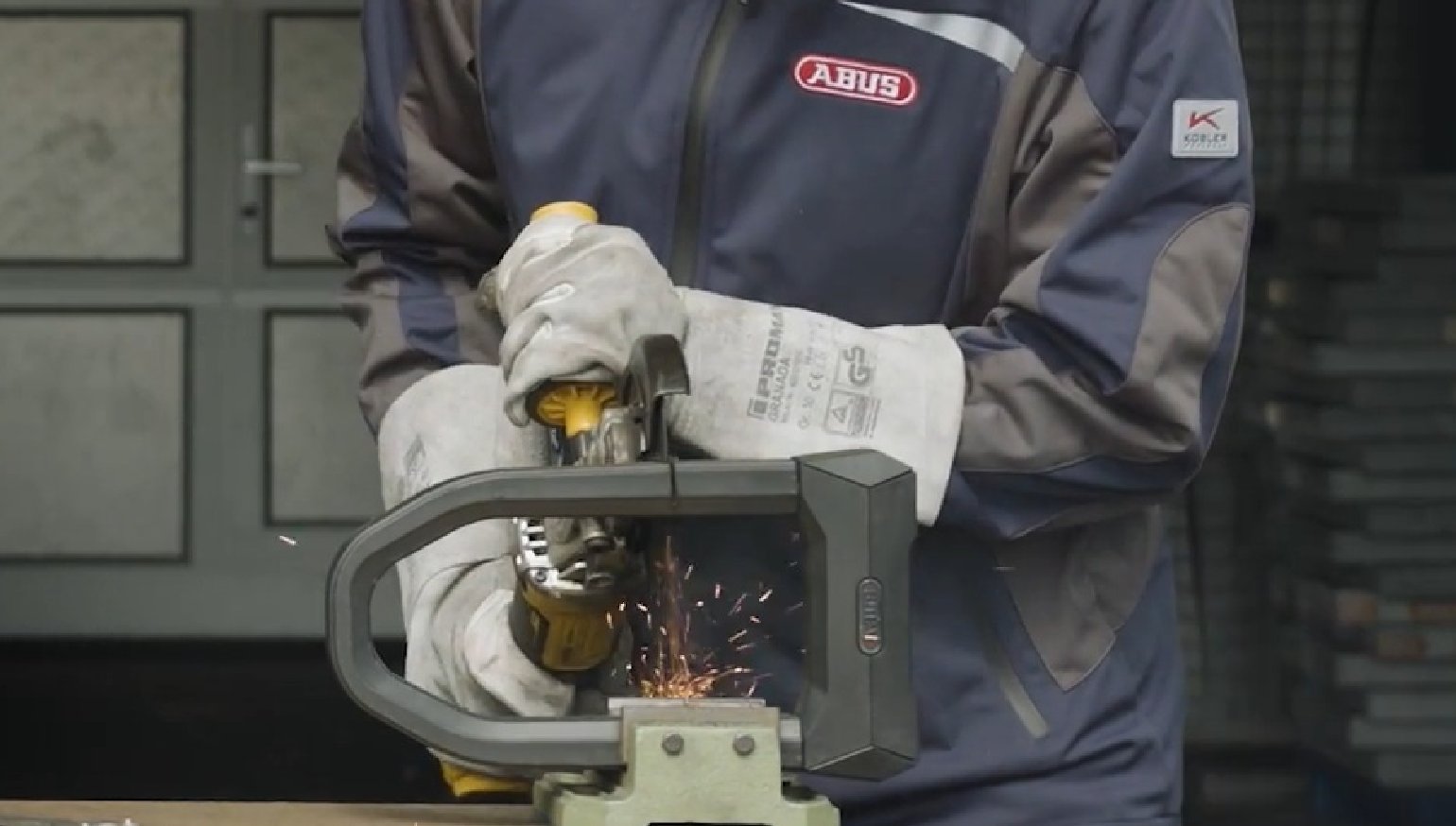
A growing trend among bicycle and motorcycle thieves in the United States and Europe is the use of portable angle grinders. While they bring more noise than bolt-cutters, angle grinders can cut through most security chains, U-locks, and loop anchors in less than a minute.

close view of chain link cut in half

That’s what happened in my case, where instead of my bike I found chain links in my garage sliced like Swiss cheese. Another weakness in my security setup was lack of a theft detection and tracking system. I’d figured that a secure garage, multiple locks, and a front wheel alarm would serve as enough of a deterrent. Well, I was wrong.

New strategy

Fortunately, security companies are bringing novel tech to market to give us a chance against shameless thieves. For my new ride, I’ve paired a basket of these tools to a tactical plan of sorts:

  • Deter
  • Delay
  • Detect
  • Track

To expand on that, you include kit in your security setup that discourages thieves from attempting to rip off your bike, that allows for mobile detection if they do make the attempt, that buys you time to respond and call the authorities, and in the event the thieves succeed offers options to track down your stolen ride.

Deter and delay

On deterrence, an affordable first step you can take is to get a quality disc lock with an integrated alarm. A number of motorcycle thefts are walkway jobs. The perpetrator can pop it in neutral, push your bike away, and look like someone who just ran out of gas.

Adding a topnotch disc lock that’s engineered to withstand a hammer or grinder could make Joe Robber walk on. ABUS’s 8077 Granit Detecto disc lock has a high-decibel alarm and has scored well in reviews for sturdiness.

Another relatively new deterrence tool is SkunkLock, which earns its name by drawing on a defense inspired by nature. Founded by two San Francisco techies who got tired of having their bicycles stolen, Skunklock offers a U-bolt lock with a hollow shackle filled with highly pressurized nausea- and vomit-inducing chemicals. Any cut into the lock releases them.

I won’t give away all the details of my new security setup, but I have incorporated Skunklock into it. I use their chemical U-bolt as both a wheel lock slid through the spokes and disk and to secure my bike to fixed structures when out and about.

Grind-resistant locks are another security upgrade I encourage anyone who hasn’t to pursue. Responding to increased use of portable angle-grinders, motorcycle security companies have developed these locks to incorporate advanced materials and design characteristics that make them difficult to slice through.

photo of anchor in concrete with a lock attached to a BMW motorcycle's wheel

A great home garage option is HipLok’s integrated grind-resistant lock, arm, and anchor that bolts into the pavement. Grind-resistant U-locks are available from companies such as Kryptonite and ABUS (shown in testing in the top photo), Oxford sells a grind-resistant anchor, and LiteLok offers a flexible and lightweight 125-centimeter (49-inch) Core Moto cable lock that boasts anti-grind technology.

It’s worth noting that none of these security tools are completely “grind-proof,” but most of these locks, when independently tested, demonstrate an ability to resist a grinder attack longer than conventional options, destroying disks and requiring several to breach.

Detect and track

Adding a motion-detection security system to your bike is a great way to top off your anti-theft setup and create time to react. Both Scorpio and GeoRide offer a security kit that combines motion detection, an alarm, and a GPS tracker all in one. With these units you can monitor your motorcycle’s location at all times from a mobile app and you get an alert if if someone nudges your bike.

So let’s round this off with how you could integrate these tools into a tactical plan for motorcycle security. A sturdy disc lock and grind-resistant locking system could deter a thief from trying to take your bike altogether.

If they do attempt the steal and deploy a portable angle grinder, grind-resistant locks could delay the thief significantly. With a motion-detection and GPS unit, you would get an alert from the vibration and have time to respond yourself or alert local law enforcement and potentially thwart the theft. In the unfortunate case that thieves succeed in taking your ride, an embedded GPS unit can assist with tracking down the bike before it ends up in a chop shop or shipping crate to country XYZ.

There you go. That’s my best advice for now. I would also add a suggestion to stay up to speed on changes and trends. As I learned the hard way, there is a cat and mouse interplay between security tech, law enforcement, and adaptation by thieves. It’s probably good practice to work in occasional research on new tech and tactics. Some good sources are the Motorcycle Safety Foundation and Bennetts Insurance UK, and some OEMs (Harley-Davidson) offer advice and tech tips.

It sucks we have to go to these lengths just to keep our rides. Perhaps in five to 10 years we’ll have affordable AI-driven autonomous security robots assigned to guard our bikes. In the interim, do your best with what’s available now to protect your motorcycle and keep riding!

Happy
Happy
0 %
Sad
Sad
0 %
Excited
Excited
0 %
Sleepy
Sleepy
0 %
Angry
Angry
0 %
Surprise
Surprise
0 %

Next year you can buy a new Harley-Davidson for $6,000

Read Time:3 Minute, 45 Second

A new Harley-Davidson with an MSRP of under $6,000 for sale in the United States? You’ll see one later this year and be able to buy it in 2026, CEO Jochen Zeitz said today.

That’s big news for the Harley-Davidson’s lineup, because not long ago the least expensive new model in the lineup cost twice that much. Company executives have been hinting for a while that new, less expensive models are coming, and Zeitz dropped a few additional details in the conference call with financial analysts today after the company released its earnings report for the second quarter of the year.

Zeitz also confirmed that the LiveWire mini moto concepts unveiled at the Harley Homecoming event this summer will also go into production.

small electric LiveWire motorcycle on display in front of a whimsical storefront backdrop

Zeitz appeared to refer to the new model as the Sprint, so presumably that will be its name. No other details beyond the name and price were revealed, though he said the model will be presented to dealers in October. Along with the Sprint, Harley-Davidson also will introduce an “iconic cruiser” next year, possibly to be named the Eagle. This is purely speculation on my part, but I believe the Eagle (if that’s what it’s finally called) is a response to calls from dealers to bring back a traditional-looking, affordable model like the XL883 Sportster.

In recent years, Harley-Davidson has sold in other markets its X 350, X 440 and X 500 models developed with partners in China and India. But those small motorcycles weren’t for sale in the U.S. market, even though they were used as trainers in the Harley-Davidson Riding Academy training course. Here in North America, the least expensive new model has been the Nightster, which originally debuted with an MSRP of more than $13,000. But Harley-Davidson has cut the price twice since then and the current MSRP is $9,999. Still, sales of the Nightster and the Sportster S have been slow, accounting for less than 10% of Harley-Davidson’s motorcycle unit sales so far this year.

image of a couple riding a X 350 on a street in Asia

The new models are an attempt to cash in on current trends toward smaller bikes. Harley-Davidson has to be looking at the sales success that Triumph has had with its single-cylinder Speed 400 and Scrambler 400 X  both of which, coincidentally, list for under $6,000 and wondering if it could also capture some of that segment.

“It’s the only area that really shows growth right now, which is really the result of the affordability issues,” Zeitz said of the small-displacement category.

Zeitz insisted the Sprint will not be a loss leader. Previous low-cost models have not been profitable, but this one will be, he said. Does that mean it will be manufactured abroad? The CEO gave no more details except to say, “We believe that how we’ve engineered this product, it will be profitable.”

Overall, Harley-Davidson’s second-quarter motorcycle retail sales were down 15% globally and 17% in North America compared to the same quarter last year. The company has also scaled back production as it continues to work to reduce the level of inventory on dealer floors.

That’s not why Harley-Davidson stock jumped 20%

The new models were the most interesting news to come out of today’s earnings report for consumers, but that wasn’t the biggest development from the perspective of the company, investors, or financial analysts. The company’s stock jumped over 20% because Harley-Davidson announced a deal to sell a portion of its Harley-Davidson Financial Services division. Financial firms KKR and PIMCO will each buy 4.9% of HDFS and will each take on a third of new loans going forward for at least the next five years. The two new partners are also buying $5 billion in loan receivables. That frees up $1.25 billion that Harley-Davidson will use to reduce debt, buy back shares, and invest in new products. 

One of the old myths you often hear about Harley-Davidson is someone claiming that the company makes more money selling T-shirts than motorcycles, which is nowhere near the truth. But it’s not a stretch to say Harley-Davidson makes more money by making loans than by selling motorcycles. In the second quarter, operating income from HDFS was $70 million compared to $61 million from the motorcycle division. Harley-Davidson executives are thrilled with the deal with KKR and PIMCO largely because it shows how valuable the financial services arm is.

Happy
Happy
0 %
Sad
Sad
0 %
Excited
Excited
0 %
Sleepy
Sleepy
0 %
Angry
Angry
0 %
Surprise
Surprise
0 %

2026 Suzuki GSX-R1000 first look

Read Time:3 Minute, 7 Second

The Suzuki GSX-R1000 is likely not the first to celebrate turning 40 by returning to Europe with a new set of clothes. It’s not a bad way to mark a milestone.

The biggest member of the Suzuki sport bike family has been absent from the European market for a few years because it would not pass stricter Euro 5 emissions requirements. The model has still been on sale in the United States, but it has been languishing without any significant updates. With the 40th anniversary of the GSX-R line hitting in 2026, Suzuki is changing that.

Suzuki played a leading role in popularizing sport bikes and making the inline-four engine the class standard for many years. For the 2026 flagship Gixxer, that four-cylinder engine gets a host of internal changes. The goal is not to increase performance so much as to get back in the game in Europe by meeting Euro 5 emissions standards as well as noise regulations. Suzuki usually does not advertise power output in the United States, but in Europe the changes necessary due to regulations are said to reduce peak horsepower slightly.

illustration of the engine and internal parts

To meet those emissions standards, Suzuki made a host of changes inside the engine that you can’t see. New parts include throttle bodies, injectors, camshafts, aluminum pistons, chrome-molybdenum steel connecting rods, crankshaft, and more. 

The GSX-R1000 retains its unique Suzuki Racing Variable Valve Timing (SR-VVT) system, which varies valve timing mechanically, without the need for hydraulic or electronic actuation.

close view of slimmer muffler

The Gixxer Thou gets the full array of electronic rider aids, informed by a six-axis inertial measurement unit. The IMU also communicates with the anti-lock braking system, in what Suzuki calls Slope Dependent Control System. When the rider is braking on a downhill slope, the ABS adjusts to limit rear-wheel lift.

studio image of the blue-and-white GSX-R1000 highlighting the carbon fiber wing on the fairing

Interestingly, with opinions often sharply divided over winglets on sport bikes, Suzuki is giving you a choice. The winglets seen here are an optional accessory that bolts on. They’re made to resemble the ones on the Suzuka 8 Hours Endurance Race bike and they’re constructed of carbon fiber laid over a core structure that burns away, leaving the finished carbon fiber wings hollow.

The main difference between the GSX-R1000 and GSX-R1000R is that the R version gets a higher grade of Showa suspension. Exact details on the suspension for U.S. models was not immediately available. In one difference from its competition, the GSX-R1000 gets an LCD display instead of the TFT display more common on today’s high-performance motorcycles.

rider on a blue and white GSX-R1000 on the track leaned over in a curve

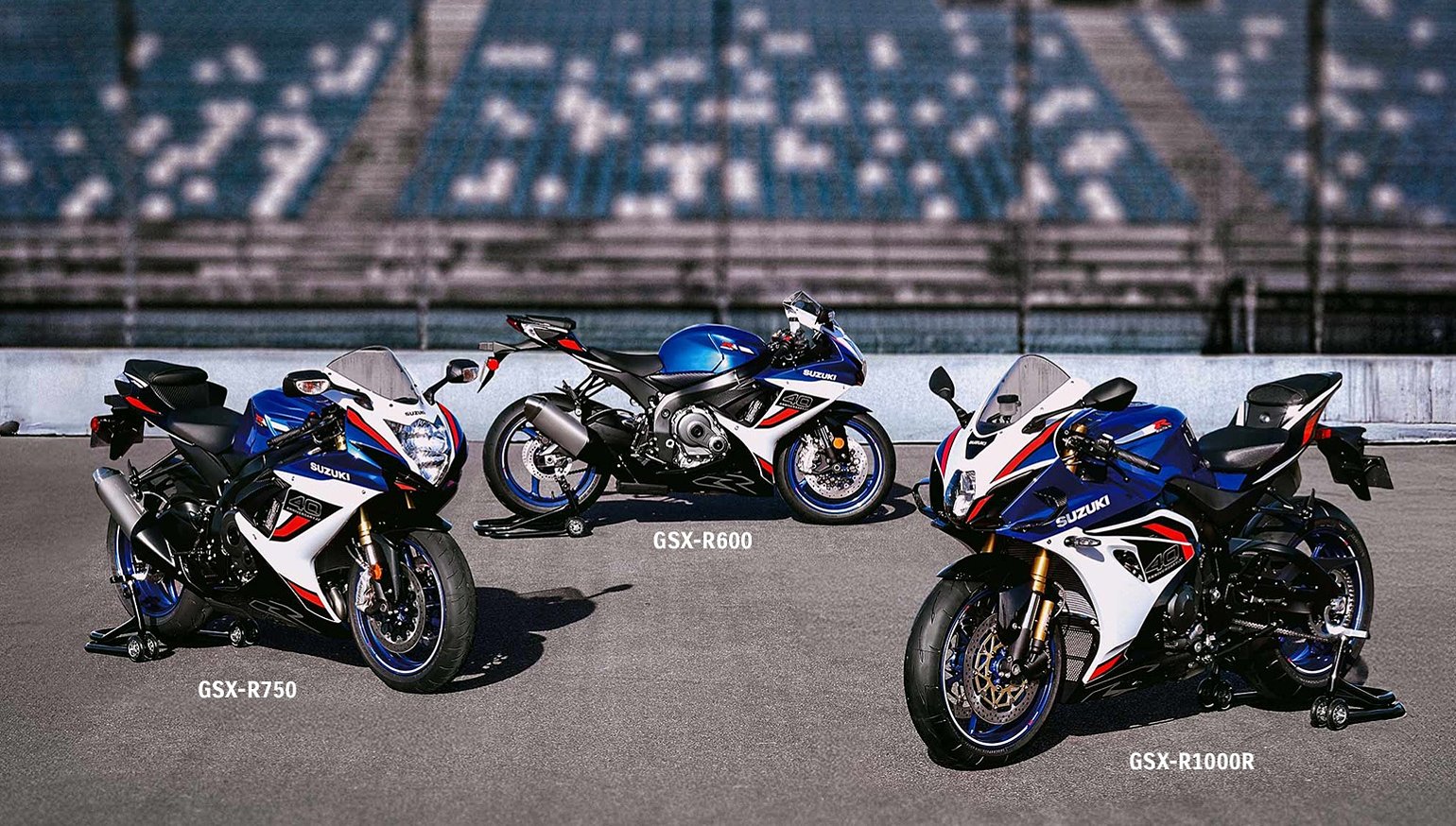
The three paint schemes for the 2026 Gixxers are intended to bring to mind some of the great Suzuki race bikes of the past. The GSX-R1000 will be available in the Pearl Vigor Blue and Pearl Tech White combo and the Pearl Ignite Yellow and Metallic Mat Stellar Blue. The GSX-R1000R will come in the blue and white or the Candy Daring Red and Pearl Tech White combo. The 40th anniversary blue-and-white paint scheme will also be available on the GSX-R600 and GSX-R750, as seen in the top photo.

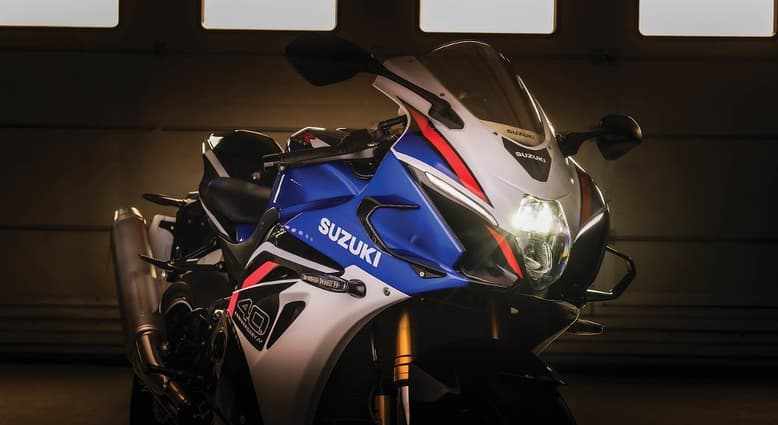
close view of 40th anniversary logo on the fairing

In what is now becoming standard practice for Suzuki, we have most of the details of the new motorcycles but not the price.

2026 Suzuki GSX-R1000
Price (MSRP)TBA
Engine999.8 cc, liquid-cooled, 16-valve, inline-four
Transmission,
final drive
Six-speed, chain
Claimed horsepowerNA
Claimed torqueNA
FrameTwin-spar aluminum
Front suspensionShowa, fully adjustable
Rear suspensionShowa
Front brakeDual Brembo Monobloc four-piston calipers, 320 mm discs, with ABS
Rear brakeNissin single-piston caliper, 220 mm disc, with ABS
Rake, trail23 degrees, 3.7 inches
Wheelbase55.9 inches
Seat height32.5 inches
Fuel capacity4.2 gallons
TiresBridgestone Battlax RS11, 120/70/ZR17 front, 190/55/ZR17 rear
Claimed weight448 pounds
Warranty12 months
Happy
Happy
0 %
Sad
Sad
0 %
Excited
Excited
0 %
Sleepy
Sleepy
0 %
Angry
Angry
0 %
Surprise
Surprise
0 %