Maeving unveils 2026 RM2 with two-up capability

Read Time:2 Minute, 42 Second

Maeving’s all-electric RM1. Its range and output may not meet the needs of all riders, but the classically styled e-roadster still appeals to Maeving’s core audience: hip, city-dwelling commuters. 

So when the British startup went back to the drawing board for the follow-up to the RM1, it aimed to pair that attractive form with additional functionality. The end product is the 2026 RM2.
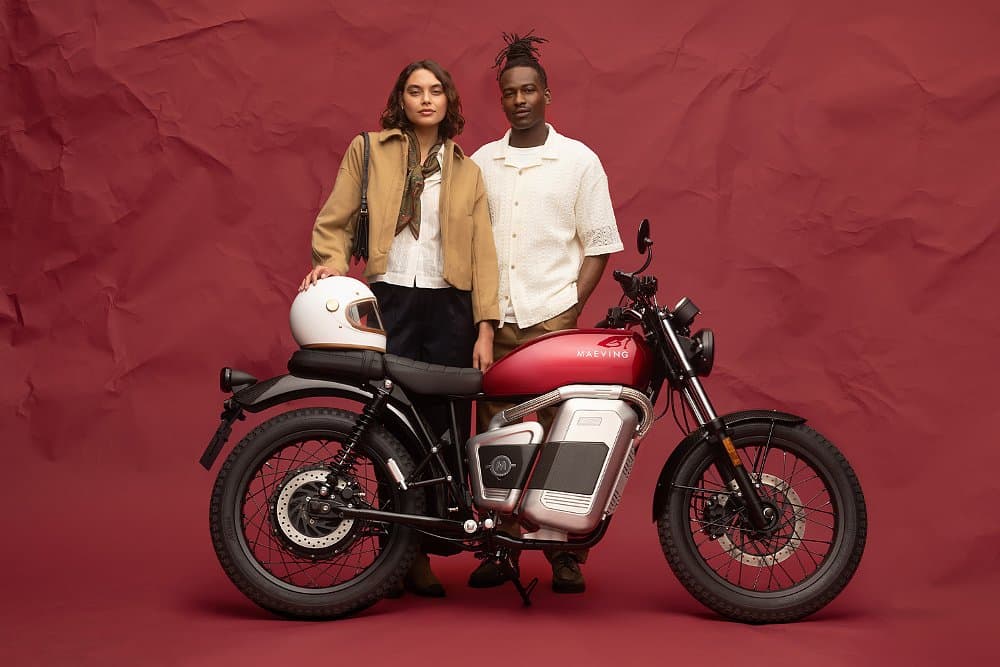
Male and female models stand next to the 2026 Maeving RM2.

As the nameplate suggests, the RM2 is Maeving’s first motorbike made for two-up riding. To accommodate a passenger, Maeving did away with the RM1’s bobber-inspired floating seat and shrunk the gas tank-shaped storage compartment to 8.5 liters of storage volume (compared to the RM1’s 10 liters). That, in turn, pulls the saddle forward, which reduces the rider’s reach to handlebar and makes room for a passenger on the one-piece seat. Two birds, one stone.

A handful of chassis revisions also headline the new model. Its rear suspension, for example, not only earns additional travel but also “more refined damping.” A frame-mounted rear mudguard may be necessary for the two-up configuration, but it also reduces the rear wheel’s unsprung weight. Meanwhile, new Mitas H-02 tires result in what Maeving characterizes as a “more planted ride,” and a larger 240 mm rear rotor reportedly yield greater stopping power and improved feel.

Given my experience testing the sporty RM1S, many of the RM2’s updates are welcome changes. On the other hand, the new electric stops short of addressing the RM1’s main limitations. 
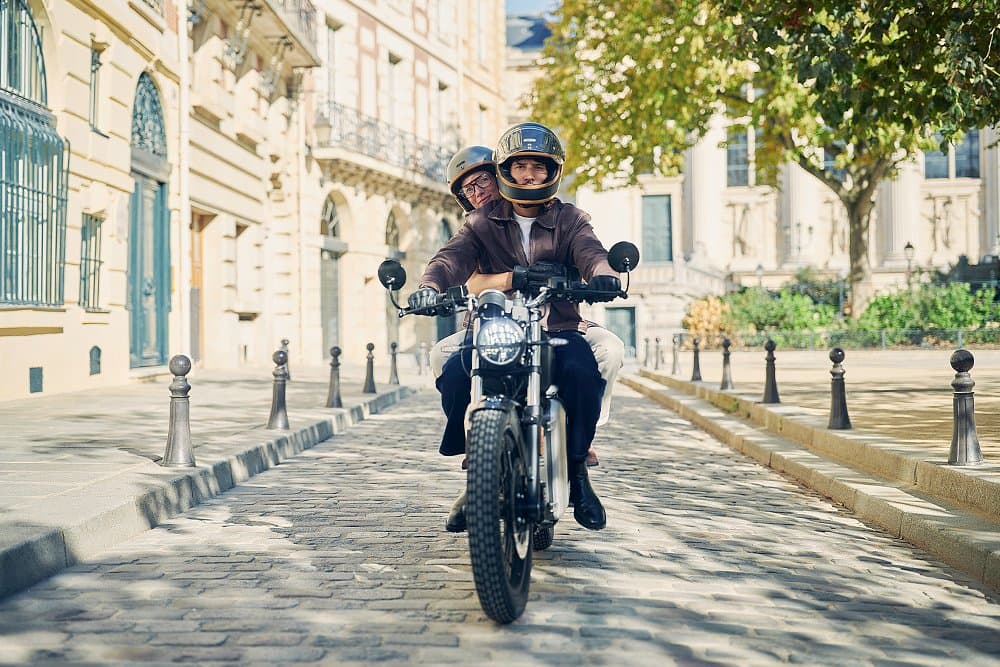
A couple rides the RM2 down a cobblestone road somewhere in Europe.

Instead of upgrading the RM2’s powertrain, Maeving carried over the same 5.46 kWh dual battery pack (2.73 kWh per battery) and brushless DB hub-mounted motor found on the RM1 and RM1S. The brand still lists that package with a combined range of 80 miles, but my trips aboard the RM1S regularly fell short of that estimate. 

An RM2 rider removes the motorbike's electric battery.
M

Per Maeving, the RM2’s powertrain still “outperforms all other 125 cc segment powertrains on the market.” The problem is, the RM2 isn’t priced similarly to other 125 cc-equivalent bikes. That includes its closest competitor, BMW’s CE 02, which starts at $7,599. Of course, the Beemer is neither passenger-friendly nor conventionally handsome, giving the RM2 a leg up in those respects. 

Only time will tell if the RM2’s marriage of form and function drives reservations, which opened on Maeving’s website this morning. 

2026 Maeving RM2
Price (MSRP)$10,995
DrivetrainAir-cooled hub motor
Claimed horsepower9.7 (7.2 kW) continuous, 14.9 (11.1 kW) peak
FrameSteel cradle
Claimed range80 miles
Claimed battery capacity5.46 kWh
Claimed charge time6.5 hours @ Level 1 (120V)
Front suspension37 mm fork; 4.3 inches of travel
Rear suspensionDual RSU shocks, adjustable for spring preload; 4.0 inches of travel
Front brakeSingle three-piston caliper, 300 mm discs without ABS
Rear brakeSingle-piston caliper, 240 mm disc without ABS
Rake, trail25.0 degrees, 4.0 inches
Wheelbase55.0 inches
Seat height30.5 inches
TiresMitas H-02, 3.50 x 19 in. front, 3.50 x 19 in. rear
Measured weight320 pounds
AvailableNow
Warranty24 months
More infomaeving.com

Please feel free to leave us your comment.

Happy
Happy
0 %
Sad
Sad
0 %
Excited
Excited
0 %
Sleepy
Sleepy
0 %
Angry
Angry
0 %
Surprise
Surprise
0 %

Polaris sells majority stake in Indian, making it a separate company

Read Time:3 Minute, 3 Second

Parent company Polaris announced today that it is selling a majority stake in the motorcycle manufacturer to a Los Angeles-based private equity firm. The deal is expected to close in the first quarter of 2026 and the new, independent Indian will be led by CEO Mike Kennedy, a former CEO at both RumbleOn, the nation’s largest powersports dealership group, and Vance & Hines, the aftermarket parts and accessories manufacturer, as well as a long-time employee at Harley-Davidson.

Purchasing the controlling stake in the company is Carolwood LP, which was founded in 2014. Polaris “will maintain a small equity position in the business,” according to the news release from Polaris. Polaris said the transaction would add about $50 million to its earnings but additional terms of the deal have not yet been disclosed.

For Indian customers and most employees, Polaris said business will carry on as usual. The new Indian will continue selling motorcycles, parts, and accessories through its 600 current dealers. The sale includes Indian’s manufacturing facilities in Spirit Lake, Iowa, and Monticello, Minnesota, as well as its industrial design and technology center in Burgdorf, Switzerland. About 900 employees will move to the new company, with “the majority of its team” being retained, according to Polaris.

Except for retaining a small stake in Indian, the sale marks the end of Polaris’ dalliance in the motorcycle business. The company, which has mostly focused on off-road vehicles over the years, first formed the Victory brand of motorcycles in 1997, building heavyweight cruisers aimed directly at Harley-Davidson. In 2011, Polaris acquired the Indian brand and in 2017 the company closed down the Victory line to focus all its efforts on Indian.

It’s yet another change in ownership for the Indian brand, which goes back to 1901, two years before Harley-Davidson was founded. The original company, founded in Springfield, Massachusetts, was once the largest motorcycle manufacturer in the world. It went out of business in 1953 and the brand changed hands several times thereafter. For years, the Indian name was slapped on scooters, mopeds, and other small imported two-wheelers. In 1999, a company was formed to build Scouts and Chiefs in the Indian tradition, using S&S engines, but it only lasted four years. The recent run under Polaris’ ownership has given the brand the most stability it has seen since the original company went out of business more than 70 years ago.

Under Polaris, Indian provided a domestic challenger to Harley-Davidson, but motorcycles have always been a small part of Polaris’ business portfolio. The company said Indian accounted for 7.0% of Polaris’ revenues over the 12-month period ending June 30, 2025.

“Polaris and Indian Motorcycle both stand to benefit from this deal, which will enable each business to move faster, deliver industry-leading innovation, and lean further into our respective market strengths,” said Polaris CEO Mike Speetzen. “For Polaris, the sale will further strengthen our focus on the areas of our portfolio that offer the strongest growth potential and allow us to accelerate investments in key initiatives and create wins with customers and dealers.”

“With its current product portfolio, global dealer network, category expertise and manufacturing resources, the business is well positioned to succeed as a standalone company with a dedicated focus on its industry,” Speetzen added. “We were highly intentional and selective in our search and planning efforts for Indian Motorcycle’s next chapter of growth. In Carolwood, Indian Motorcycle has a partner that believes in building on the business’ current momentum and supporting its next stage of success.”

Reportedly, Carolwood has never sold any of the assets it has acquired.

Happy
Happy
0 %
Sad
Sad
0 %
Excited
Excited
0 %
Sleepy
Sleepy
0 %
Angry
Angry
0 %
Surprise
Surprise
0 %

Kawasaki confirms 2026 Z1100 SE for U.S. market

Read Time:2 Minute, 49 Second

In late September, Kawasaki officially confirmed the 2026 Z1100 and Z1100 SE for European markets. That announcement only left U.S. customers wondering, “What about us?”

After nearly two weeks of delay, Team Green just answered in the affirmative. Well, for the SE variant, at least.

A Kawasaki Z1100 rider wheelies on the race track.

Powering the 2026 Z1100 SE is Kawasaki’s recently refreshed 1,099 cc inline-four. Complete with larger 38 mm throttle bodies, updated cam profiles, and new valve springs, it’s the same engine that debuted in the Ninja 1100SX SE and Versys 1100 SE LT earlier this year. Even the output remains virtually identical to those two models at 134 horsepower (at 9,000 rpm) and 83.3 foot-pounds of torque (at 7,600 rpm). 

The Kawasaki Z1100 SE pictured with a sunset in the background.

The four-cylinder mill also acts as a stressed member of the Z1100’s aluminum twin-tube frame. Kawasaki claims the duo yields “sharp handling and direct rider feedback.” Characteristics reportedly preserved by the engine’s three rigid mounts and one rubber mount. 

A close-up of the Kawasaki Z1100 SE's frame and engine.

For suspension duties, the SE turns to a big-piston, separate-function fork from Showa and a gas-charged Öhlins S46 rear shock. The former boasts full adjustability while the latter offers rebound and preload adjustments.

To support the SE’s sporty ambitions, Kawi equips the supernaked with a wealth of IMU-driven rider aids. There’s Kawasaki Cornering Management Function (KCMF), which “modulates brake force and engine power to assist the rider” through the corner. There’s Kawasaki Traction Control (KTRC) and Kawasaki Intelligent anti-lock Brake System (KIBS). Even a quickshifter and cruise control come standard. 

A top-down view of the Z1100's five-inch TFT dash.

In many ways, the Z1100 SE is the spiritual successor to the Z1000. Not just in its role at the top of Kawasaki’s (non-supercharged) Z range, but in appearance, too. The Japanese marque calls attention to the model’s “concentrated mass toward the front and the flick-like tail cowl” as well as its “slim LED headlamp,” but that’s just the long way of saying the Z1100 looks identical to the 2014 Z1000.

As the image slider above illustrates, the Z1100 is a bit of a copy/paste job. It’s difficult to fault Kawasaki for plagiarizing itself, though. After all, it sure seems like Ducati’s Streetfighter series and Honda’s CB1000 Hornet SP drew heavy inspiration from the Z1000. Why can’t the Z1100? 

Starting at $14,999, the reasonably priced Z1100 SE joins the increasingly crowded and competitive liter-plus naked bike category. It may have taken Kawasaki a few days to confirm the model for the U.S. market, but units are already rolling into dealerships around the country.

2026 Kawasaki Z1100 SE
Price (MSRP)$14,999
Engine1,099 cc, liquid-cooled, 16-valve, inline four
Transmission,
final drive
Six-speed, chain
Claimed horsepower134 @ 9,000 rpm
Claimed torque83.3 foot-pounds @ 7,600 rpm
FrameAluminum twin-tube
Front suspensionShowa Separate Function Fork – Big Piston (SFF-BP) 41 mm fork, adjustable for spring preload, compression, and rebound damping; 4.7 inches of travel
Rear suspensionÖhlins S46 shock, adjustable for spring preload and rebound damping; 5.4 inches of travel
Front brakeDual Brembo M4.32 calipers, 300 mm discs with ABS
Rear brakeSingle-piston caliper, 250 mm disc with ABS
Rake, trail24.5 degrees, 4.0 inches
Wheelbase56.7 inches
Seat height32.1 inches
Fuel capacity4.5 gallons
TiresDunlop Sportmax Q5A, 120/70ZR17 front, 180/55ZR17 rear
Claimed weight487 pounds
AvailableNow
Warranty12 months
More infokawasaki.com

Happy
Happy
0 %
Sad
Sad
0 %
Excited
Excited
0 %
Sleepy
Sleepy
0 %
Angry
Angry
0 %
Surprise
Surprise
0 %

Italy’s Daytona: Scenes from Italian Bike Week 2025

Read Time:1 Minute, 9 Second

That’s when a group of bikers from Friuli Venezia Giulia, a region of northeast Italy, banded together to create the first annual Biker Fest International. They envisioned a show that could rival German Bike Week, Daytona, and Sturgis. Gaining that level of notoriety would take some time, though. 

Beset by rainy weather, the inaugural installment drew a total of 850 visitors and 400 motorcycles. The only way was up, and BFI did just that. In 1990, attendance rose to 4,000. By the turn of the century, total participants totaled 32,000 and parked bikes reached 17,000. The festival only carried that momentum into the new millennium.

A view of the Adriatic Sea from the cockpit of a Harley-Davidson bagger parked on a Lignano Sabbiadoro dock.

BFI’s continued growth called for several venue changes throughout the 2000s. In 2004, the show was held at San Daniele del Friuli before shifting to Sutrio the following year. After the commune of Osoppo played host in 2011, the rally found its true home, Lignano Sabbiadoro, in 2012. The resort town soon earned BFI the title of the “Italian Daytona.” 

Even after Biker Fest International rebranded to Italian Bike Week in 2022, the event still returns to Lignano Sabbiadoro every year. It’s no different in 2025, but the show’s activities are more diverse than ever. Scenes from the fourth-annual IBW prove as much.

Two dirt bike riders trudge through the mud of the Italian Bike Week's test trail.
Endless rows of Harley-Davidson baggers ride down a Lignano Sabbiadoro street during sunset.

Another year has come and another Italian Bike Week has gone.

Happy
Happy
0 %
Sad
Sad
0 %
Excited
Excited
0 %
Sleepy
Sleepy
0 %
Angry
Angry
0 %
Surprise
Surprise
0 %

BMW and Honda tease new electric concepts

Read Time:2 Minute, 33 Second

BMW wants the viewer to know that it remembers the C1, the firm’s first crack at an enclosed scooter. Introduced in 2000, the model was poorly received by critics and consumers alike, with weak sales prompting its demise after just two years. For decades now, the C1 has become the butt of many moto-related jokes. 

A casually dressed rider guides the BMW C1 enclosed scooter through an urban landscape.

By acknowledging the C1, BMW tries to get ahead of all the naysayers. It isn’t a repelling tactic, altogether. After all, self-deprecation can be quite disarming. It’s the way the teaser presents the product after that fleeting moment of self-awareness that proves that even if you’re in on the joke, you can still be the butt of the joke.

A stylish female rider mounted on BMW's Vision CE e-scooter concept with a light installment in the background.

BMW’s recent reliance on generative A.I. is well documented. (I’ve openly griped about it at times and bit my tongue at others.) The Vision CE campaign only takes that trend to unsettling new heights. Everything from the footage to the music to the voiceover looks, sounds, and feels A.I.-generated. However, it’s how the video ends that truly leaves me scratching my head.

A split image of the BMW Vision CE concept outfitted as a mobile DJ booth and overlanding vehicle.

After the narrator triumphantly identifies the concept as the Vision CE, they deliver the predictable, “Coming Soon.” Following a long beat, they add, “Or Later.” Only after another extended pause, do they conclude with a cryptic, “Maybe.” It’s a cheeky sign-off, but it also brings BMW’s intentions for the model into question. 

A chart of all the BMW Vision CE variations possible thanks to its modular accessories system.

In 2021, Honda unveiled its long-term pathway to electrification. It followed up that announcement in 2022, providing a silhouetted look at three of its “FUN” EV models. By 2023, the company accelerated its original plan, now aiming to introduce 30 new electric motorcycle models by 2030. The “FUN” concepts remained shrouded all the while. That is, until EICMA 2024, when the EV Fun prototype finally broke cover. 

A side profile shot of Honda's EV Fun Concept from EICMA 2024.

Along with that debut, Big Red promised to roll out the production-version of the e-roadster sometime in 2025. That’s why I paid close attention when Honda released a teaser for its “first electric motorcycle” in late July, especially with the date of September 2, 2025, dominating the screen by the video’s end. I marked my calendar, and everything. Sadly, it was all for naught, as the video Honda launched on Tuesday proved underwhelming. 

Instead of rolling out the homologated model, the brand showcased the final stages of prototype testing. Sure, the bike wore street-going mirrors, lighting, and a license hanger for the first time, but there’s no real developments to report. No new specs, no pricing, and no release date. Womp womp. Honda effectively released a teaser for a teaser. Talk about dragging your feet.

Of course, with EICMA 2025 just two months away, I wouldn’t be surprised if both Honda and BMW save their big reveals for the annual trade show. Until then, that leaves us pondering the ultimate question: When the EVs arrive, will either make a real difference in the struggling electric two-wheeler market?

Happy
Happy
0 %
Sad
Sad
0 %
Excited
Excited
0 %
Sleepy
Sleepy
0 %
Angry
Angry
0 %
Surprise
Surprise
0 %