

Yes, safety and convenience are good things. But like anything, too much of a good thing can also be a bad thing. As OEMs cram more and more technology into today’s motorcycles, it seems like things are trending that way.
TFT (thin-film transistor) displays have become standard equipment over the past decade. Even beginner bikes like KTM’s 390 Duke and Kawasaki’s Z500 SE now come outfitted with full-color dashes. TFTs aren’t just ubiquitous, though. They’re also bigger.

In October, KTM introduced a new eight-inch vertical display. As large as that sounds, BMW’s 10.25-inch unit found on select R 1300, R 18, and K 1600 models dwarfs all competition. Now more than ever, that extra screen space makes room for GPS navigation, music playback, or incoming messages and calls. Each feature may present a convenient new tool to the rider, but at the same time, they also present a new distraction.
Even if you forego all of today’s digital luxuries (like I often do), it doesn’t mean your ride is free of distractions. At least, that’s what I learned when testing Ducati’s XDiavel V4. Like the Panigale V4 superbike, Ducati’s muscle cruiser now sports a 6.9-inch TFT display. It’s glare-resistant, thanks to Optical Bonding technology. It’s panoramic, with an 8:3 aspect ratio. In short, the XDiavel’s dash commands attention. Maybe a little too much attention at times.

Aside from displaying secondary readouts like trip meters, range, and engine temperature, the XDiavel’s screen also relays less critical data, such as torque and power output. There’s even a G-force meter. It’s those settings that often drew my attention away from the road at the worst time possible.
Power and torque values reach their peak under heavy acceleration. The highest G-force measurements occur while cornering. Both scenarios require the rider’s full concentration. Yet, the performance metrics often lured my eyes away from the task at hand. I couldn’t help but wonder how many Gs I was pulling or how much power I was using. My curiosity (and my ego) often got the best of me. It’s an unintended byproduct of the XDiavel’s top-of-the-line electronics suite. That’s not always the case, though. Some quirks are by design.

Large, colorful TFTs aren’t the only distractions riders contend with. The controls that operate those big, beautiful screens can interfere with the riding experience, as well. My time spent aboard the 2025 Z900 SE illustrates that point best.
There are two rocker switches at Z’s left hand grip. Kawasaki stamps both with a Mode label. That’s why I assumed tapping each button would shuffle through the model’s ride modes. Well, you know what they say about assuming. Instead, the top button changed the dash’s lower left readout while the bottom button cycled the lower right readout. Makes sense (he said sarcastically).

When it comes to safety, proper button functionality is key. That much is evident. But the sheer number of buttons on modern motorcycles can be just as disruptive. Practically all new bikes come with a smartphone pairing technology that mirrors directions and music playback onto the motorcycle’s dash. Such features are often a source of distraction. That goes beyond the image on the screen, too.
I’ve already aired my frustrations with the Honda NT1100’s Apple CarPlay and the Yamaha MT-09’s Y-Connect. But, here’s the thing, no matter how functional (or dysfunctional) an infotainment system is, it isn’t mission critical. If it doesn’t connect, or if you bypass altogether, it’s out of your way. Finito. End of conversation. The same can’t be said for the buttons that come along with such systems.
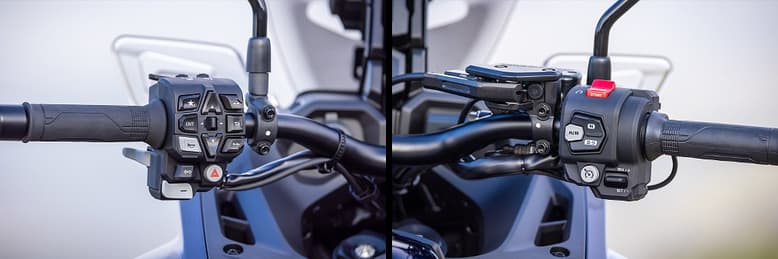
If crowded controls were a crime, the NT1100 DCT would be guilty on several counts. With nearly 25 buttons split between its two switchcubes, there’s no shortage of options at the rider’s fingertips. On the other hand, the NT’s jumbled layout also proved problematic. Even after familiarizing myself with the sport-tourer over two days, even after racking up 315 miles in its saddle, I still found myself looking away from the road to make on-the-go adjustments. I doubt Honda foresaw that outcome when it configured the NT’s controls. One solution to that problem is return to simplicity.
Simple can be harder than complex
Sometimes, more is less. That’s especially true when you’ve reached the complexity level of modern motorcycles. It’s also a build mantra that manufacturers can adopt for future lineups. In fact, Yamaha already did as much with the Tracer 9.

For years, the crossover tourer was the recipient of Team Blue’s latest innovations. The 2021 Tracer 9 GT arrived with electronically controlled suspension, IMU-informed rider aids, and a dual-pane TFT dash. By 2024, the Tracer 9 GT+ gained radar-assisted adaptive cruise control and emergency braking system. None of those upgrades resonated with customers, unfortunately, forcing Yamaha to return to the base model Tracer 9 in 2025.

Technology enhances the safety and convenience of modern motorcycles. That’s indisputable. At the same time, if technology becomes a distraction, those end goals are quickly compromised. Motorcycle electronics have come a long way over the past decade. What do you think ?


