Motorcycle industry prepares for Trump 2.0

Read Time:3 Minute, 10 Second

The industry will face both old and new issues over the next four years, said Scott Schloegel, senior vice president and head of the Government Relations Office for the Motorcycle Industry Council. The MIC’s two main areas of focus on the legislative side haven’t changed: funding for the Recreational Trails Program (RTP) and the various laws being enacted at the state level to restrict use of PFAS or so-called “forever chemicals.”

Gasoline taxes are used to pay for highway construction and also for off-road trails through the RTP, but off-road riders have long complained that the amount of taxes they pay is far larger than the share of funds that go to the RTP, and part of the RTP funding is for non-motorized trails. Schloegel noted that Sean Duffy, Trump’s nominee for Secretary of Transportation, and Doug Burgum, the nominee for Secretary of the Interior, are from Wisconsin and North Dakota, respectively, are familiar with outdoor recreation issues, and are likely to be supportive of the MIC’s goals in this area.

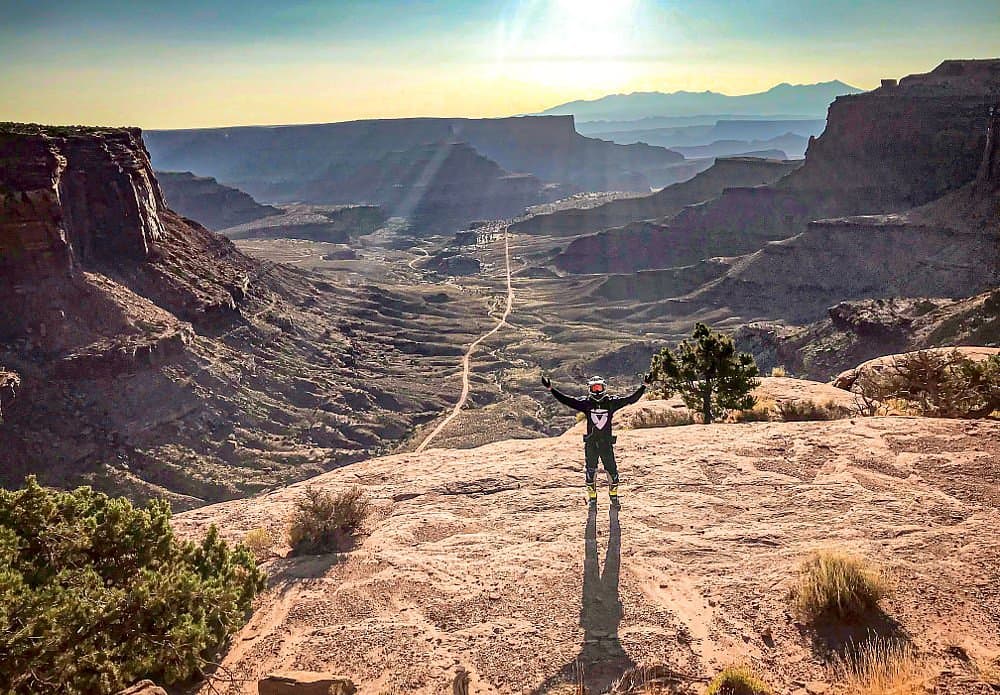
photo of rider in off-road motorcycle gear standing on a rock with a view of a trail and desert cliffs and mountains in the background

PFAS laws, which we’ve written about before, have the potential to affect a wide range of products in the industry because the chemicals are used in everything from waterproof riding gear to O-rings and gaskets. Since regulations are being introduced in various forms in different states, the issue is also a more complex and time-consuming one for the MIC.

Aside from those old issues, the newest and most uncertain issue that could affect the industry is Trump’s threat to impose broad tariffs on imports.

The top three countries that import goods into the United States are, in order, Mexico, China, and Canada, Schloegel noted. Trump has talked of imposing 25% tariffs across the board on imports from Mexico and Canada and increasing tariffs on goods from China. And there’s no guarantee that tariffs would end there, because not only does Trump favor them, but he has packed his Cabinet with others who support them. Considering that everything from apparel to motorcycle parts and components are sourced from locations all over the world, this issue “could have a devastating impact on all of us,” Schloegel said.

The reality is that tariffs are far from free money. The added costs will either be absorbed by the seller, reducing profit margins, or passed on to the consumer, raising end prices, Schloegel said.

“Mexico doesn’t pay it. Canada doesn’t pay it. China doesn’t pay it. We pay it,” Schloegel said. “It will also have an extremely inflationary impact on the United States.”

Schloegel said there are a couple of reasons to be hopeful, however. While Trump has often talked about taking actions “on day one,” reality may be a little different. Schloegel noted that when Joe Biden enacted some tariffs, they were proposed in May but didn’t take effect until September because of the usual processes followed for putting them in place. To get around that, Trump would have to take an extraordinary measure such as declaring a national emergency, which could face legal challenges.

Some segments of the motorcycle industry could also benefit from exceptions, as well. Schloegel noted that during the first Trump administration the industry got an exemption for tariffs on imported motorcycle helmets, to give one example. Why? No DOT-approved motorcycle helmets are manufactured in the United States so putting a tariff on imports did nothing to help any U.S.-based business. If broad tariffs are enacted, then the focus will likely shift to the tedious detail work of lobbying for exceptions, which doesn’t get the headlines that 25% tariffs across the board do.

This inauguration day, even more than most, the regulatory landscape is shifting and uncertain and the motorcycle industry will no doubt face some more surprises over the next four years.

Happy
Happy
0 %
Sad
Sad
0 %
Excited
Excited
0 %
Sleepy
Sleepy
0 %
Angry
Angry
0 %
Surprise
Surprise
0 %

2025 Stark VARG EX first look: Stark Future’s first road-legal enduro

Read Time:3 Minute, 17 Second

Barcelona-based startup Stark Future became the overnight darling of the electric motorcycle industry when it debuted the VARG e-motocrosser in 2021. Ten thousand pre-orders and widespread critical acclaim followed soon after, solidifying the upstart’s position within a segment where others before it had not survived. Now, Stark Future hopes to expand upon that success by introducing its first road-legal enduro: the VARG EX.

Much of the EX is based on the off-road-only VARG MX model. That includes its tubular steel frame and carbon-fiber subframe, which the brand claims “doubles as a cooling funnel for the drivetrain.” While the EX still utilizes its battery as a stressed member of the frame, Stark outfits the electric dual-sport with a larger 7.2 kWh power pack (compared to the MX’s 6.5 kWh battery). 

A dual-sport rider wheelies the Stark VARG EX over a hill.

Those extra kilowatt-hours push the model’s range somewhere between 1.3 to 6 hours. According to Stark, that’s a 20% range increase over the MX (even though it reports up to 6 hours of riding time for the electric dirt bike, as well). The Spanish firm also lists a two-hour recharge interval when using the EX’s supplied 3.3 kW charging stand. However, that rating is based on 240-volt outlets commonly found in Europe. U.S. households are often equipped with 120-volt sockets. Stark does offer an adapter for such cases, but that method also extends charging times.

The VARG EX's 7.2 kWh batteries sit on a bench at the Stark Future factory.

Whether purchased in the 60-horsepower Standard variant or the 80-horsepower Alpha package, the VARG EX offers customizable power delivery, engine braking, and regenerative curve settings via its handlebar switch (five available modes).

While the EX borrows heavily from the MX, pivotal changes prep it for the dual-sport life. First off, Stark Future recalibrated the KYB suspension for enduro duty. Meanwhile, a 4,000-lumen headlamp, sleek taillight, and integrated license plate holder come in handy when it’s time to jump back on the pavement. All U.S.-bound units will come stock with a foot-operated rear brake pedal, but Stark will also include a hand brake (not mounted) for off-road use only.

The Stark VARG EX's silicone indicator shown blinking in a studio setting.

Each EX also includes Stark Arkenstone, a detachable Android-powered device that functions as the onboard system’s user interface. Arkenstone not only allows riders to adjust power settings on the go but also offers turn-by-turn navigation and GPS recording features.

Pre-orders for the VARG EX are currently open, with the 60-horsepower model starting at $12,900 and the 80-horsepower flagship going for $13,900. Both options are available in Stark Red, Snow White, and Forest Gray color schemes. Stark estimates that the first VARG EX shipments will arrive stateside in Q1 2025.

The Stark VARG EX lineup pictured in Snow White, Stark Red, and Forest Grey liveries.

Unlike the MX, which is meant for closed-course motocross tracks, the EX is built to explore trails and backroads. For that reason, its practical range is much more significant. The only way to attain that information is to ride the VARG EX, which we at Common Tread hope to do in the first half of 2025. Until then, let us know what you think of Stark’s first road-legal offering, and drop any questions you have in the comments.

 2025 Stark VARG EX
Price (MSRP)$12,900 (Standard), $13,900 (Alpha)
Drivetrain360V electric PMAC
Claimed horsepower60 (Standard)/80 (Alpha)
FrameTubular steel
Claimed range1.3-6 hours
Claimed battery capacity7.2 kWh 
Claimed charge time2 hours @ Level 2
Front suspensionKYB 48 mm fork, adjustable for compression and rebound damping; 11.8 inches of travel
Rear suspensionKYB shock, adjustable for spring preload and compression damping; 11.9 inches of travel
Front brakeSingle Brembo two-piston caliper, 260 mm disc without ABS
Rear brakeBrembo single-piston caliper, 220 mm disc without ABS
Rake26.1 degrees
Wheelbase58.6 inches
Seat height38.9 inches
TiresMetzeler 6 Days Extreme Medium, 90/90-21 front, 140/80-18 rear
Claimed weight264 pounds
AvailableQ1 2025
Warranty24 months

Happy
Happy
0 %
Sad
Sad
0 %
Excited
Excited
0 %
Sleepy
Sleepy
0 %
Angry
Angry
0 %
Surprise
Surprise
0 %

Harley-Davidson’s name dragged into talk of tariffs

Read Time:3 Minute, 14 Second

When it comes to symbolism, it seems no products are more American than bourbon and Harley-Davidson motorcycles. At least it feels that way — because when talk of trade wars and retaliation starts up, as it is right now, whiskey and motorcycles get targeted.

When president-elect Donald Trump recently talked about putting a 25% tariff on all goods entering the United States from Mexico and Canada as a way to pressure the neighboring countries on border issues, Canadian Prime Minister Justin Trudeau mentioned the last round of trade policy retaliation in 2018 during the first Trump administration, when Harley-Davidson motorcycles were targeted, along with other American products. With Trump threatening tariffs on a variety of countries, should Harley-Davidson be worried?

Well, maybe. A little. But let’s try to look at this without some of the far-too-common “Oh my God Harley’s doomed” hyperbole.

In 2023, 60.5% of Harley-Davidson’s retail sales of motorcycles were in the United States. The Asia Pacific region and the EMEA region (Europe, Middle East, Africa) each accounted for just under 17% of sales. In case you’re wondering about that emerging spat with Canada, 4.6% of sales were made north of the border, or 7,422 motorcycles.

In the first Trump administration, Harley-Davidson got dragged into a dispute with the European Union when the U.S. government imposed tariffs on steel and aluminum. The EU threatened to slap a 56% tariff on Harleys, which the company estimated would have cost it at least $200 million a year.

Harley-Davidson initially got around the tariffs by shipping motorcycles built at its Thailand plant to Europe and saying they weren’t from the United States. That won’t work in the future, because an EU court ruled against that approach and, in any case, the EU can always just put tariffs on a company’s products regardless of where they are produced.

In the end, the trade dispute was resolved after the Biden administration took over.

Since the scenario is different this time, with the president-elect talking about tariffs on goods from China, Canada, and Mexico, in addition to the EU, the events from the first Trump administration may not be all that helpful in guessing what will happen this time. But with Harley-Davidson and other companies already revising downward their sales projections for this year, new tariffs won’t help.

And then there’s another potential twist that’s even more speculative. What if Harley-Davidson got hit by tariffs from the other direction? As we reported earlier this year, for the first time ever Harley-Davidson will be building motorcycles outside the United States that will be sold in the U.S. market, specifically its Revolution Max models, the Pan America, Sportster S, and Nightster. That’s a change of policy because previously the motorcycles built at plants abroad were destined only for foreign markets.

Listen, because of the company’s symbolic prominence, there tends to be too much hysteria all around when it comes to discussions of Harley-Davidson. I noticed a headline on another motorcycle web site that literally asked “how long can it survive” on a story about the company, despite a down quarter, posting a profit — not a loss, a profit — of $119 million for the three-month period. Then you have outrage-farming YouTubers who, for their own personal gain, attack the company for being too “woke” and you have legions of other people loving and hating the company beyond reason… just because it’s Harley-Freakin’-Davidson, y’all.

Setting aside the overreactions, it’s not hype, however, to say that new tariffs and resulting retaliatory measures could add one more headwind (or headache) for the U.S. motorcycle company with by far the most international sales. When foreign governments go looking for a juicy, symbolic, American target, it’s easy to think of a Harley-Davidson.

Happy
Happy
0 %
Sad
Sad
0 %
Excited
Excited
0 %
Sleepy
Sleepy
0 %
Angry
Angry
0 %
Surprise
Surprise
0 %

2025 BMW R 12 S: The rebirth of the R90S?

Read Time:2 Minute, 51 Second

That’s what I blurted when I opened the press release for the 2025 R 12 S. 

Last year, BMW introduced the R 12 cruiser and rebranded the R nine T as the R 12 nineT. Now, the lineup earns a third model with the arrival of the cafe-styled R 12 S. 

A stylish female rider walks up to a parked BMW R 12 S.

Racing roots

BMW considers the R 90 S its “first superbike.” That’s an understandable label, given the model’s 67 peak horsepower, 124-mph top speed, and double-disk front braking system. All benchmarks at the time of the bike’s 1973 debut. It wasn’t long before the boxer-driven Beemer put that performance to good use. In 1976, the R90S won both the Isle of Man Production TT and Daytona 200, and Reg Pridmore won the 1977 AMA Superbike Championship on one. 

A three-quarters view of a 1975 BMW R 90 S Daytona Orange with a white background.

Despite the model’s racing pedigree, most moto enthusiasts associate the R90S with its eye-catching Daytona Orange livery. That’s what BMW is counting on for the 2025 R 12 S. 

The resemblance to the iconic model is evident in the R 12 S’s Lava Orange Metallic paint, clear-coated aluminum insets, and double red pinstriping. Even the side panel badge pays homage to the classic BMW, with its red ‘S’ mimicking the  R90S’s red “900” medallion. Of course, there’s no missing the bikini fairing and tail cowl, but that’s just a taste of the model’s upgrades. 

The full package

In addition to its R90S-inspired bodywork, the S-tier entry earns a slew of accessory add-ons such as Option 719 spoked wheels, a short tail section (with integrated LED lighting), and a swingarm-mounted license plate bracket.

A male rider pilots the R 12 S down an urban street.

Technology also elevates the 12 S, with Shift Assistant Pro enhancing its sporty character while Hill Start Assist and Headlight Pro highlight safety. Convenience isn’t lost on the Heritage model, either. Cruise control serves the travel-inclined and heated grips combat colder conditions. As expected, all these accessories come with a markup. 

Price to pay

Starting at $21,590, the R 12 S doesn’t quite qualify as budget-friendly. But, the real question is whether it’s worth the up-charge. Considering the model comes standard with BMW’s Select Package, two billet component packages, and accessories, it makes a pretty good case for that price point. A similarly equipped R nineT will run you $22,257.86. That means BMW includes the R90S-style paint job as an added bonus.  

Most potential buyers will consider those savings when the R 12 S rolls into BMW showrooms in Q1 2025. However, I’m willing to wager that the model’s looks will play a bigger part in that decision. 

2025 BMW R 12 S
Price (MSRP)$21,590
Engine1,170 cc, air/liquid-cooled, eight-valve, flat twin
Transmission,
final drive
Six-speed, shaft
Claimed horsepower109 @ 7,000 rpm
Claimed torque85 foot-pounds @ 6,500 rpm
FrameTubular steel trellis
Front suspension45 mm fork, adjustable for spring preload, compression, and rebound damping; 4.7 inches of travel
Rear suspensionMonoshock, adjustable for spring preload and rebound damping; 4.7 inches of travel
Front brakeDual four-piston calipers, 310 mm discs with ABS
Rear brakeTwo-piston caliper, 265 mm disc with ABS
Rake, trail27.7 degrees, 4.4 inches
Wheelbase59.5 inches
Seat height31.3 inches
Fuel capacity4.2 gallons
Tires120/70ZR17 front,  180/55ZR17 rear
Claimed weight485 pounds
AvailableQ1 2025
Warranty36 months/36,000 miles

Happy
Happy
0 %
Sad
Sad
0 %
Excited
Excited
0 %
Sleepy
Sleepy
0 %
Angry
Angry
0 %
Surprise
Surprise
0 %

The winter storage myth that hurts your motorcycle.

Read Time:2 Minute, 46 Second

Many riders believe that when your bike is in storage, starting it every month or maybe even every few weeks is a good idea to keep the battery charged, circulate oil so the engine is properly lubricated, and help keep the fuel system from gunking up.

Those all sound like good things, except they’re accompanied by a fairly serious problem: moisture.

You’ve probably noticed water dripping out of a car’s tailpipe at a stop light and we’ve all seen clouds of steam coming from the exhaust at startup on a cold day. That’s because when gasoline burns, the carbon and hydrogen atoms in the gas combine with oxygen in the air to produce carbon dioxide and dihydrogen monoxide, which is a fancy name for water.

Idling motorcycle with exhaust steam

When the engine is still cool, that steam will condense into water and can cause all kinds of trouble, from rusting your valves and acidifying your oil to ruining your O2 sensors and corroding the exhaust. 

If combustion creates all this water, then why isn’t it a concern during normal use? Because, when you actually ride the bike, putting the engine under load and revving it up, everything from the cylinder head on down to the drain plug and back to the muffler tip gets scorching hot, so the water vapor can’t condense into a corrosive liquid. 

If combustion creates all this water, then why isn’t it a concern during normal use? Because, when you actually ride the bike, putting the engine under load and revving it up, everything from the cylinder head on down to the drain plug and back to the muffler tip gets scorching hot, so the water vapor can’t condense into a corrosive liquid. The Storage Myth That Hurts Your Motorcycle | The Shop Manual

However, when people start their bikes during winter storage, they usually only do it for a few minutes. Running the bike for a brief time doesn’t heat everything up enough to prevent condensation. It’s equivalent to the type of short trip that most owner’s manuals classify as the “severe use” that dictates more frequent oil-changes. 

But what about the battery, oil, and fuel problems that starting your bike is supposed to avoid? How do you deal with those? 

The lubrication thing really isn’t an issue since oil is exceptionally good at sticking around and never really abandons a surface. Plus, cold startups are the most wear-intensive thing an engine can experience, so why add unnecessary stress? 

Gas going bad is a real concern, so you should fill your tank with fresh fuel and treat it with a stabilizer, which will keep it good for several months. Or just drain the tank. Siphon the fuel out and run the bike until it stalls for fuel-injected motorcycles, or drain the float bowls on carbureted bikes. On the surface, starting the bike during storage sounds like a good idea, but the way most people go about it, it could be causing more harm than good. So as tempting as it is to exercise your bike during its winter nap, you’re much better off prepping the bike properly before storage and then just leaving it alone until you’re actually ready to ride it. 

Leave us your comment.

Happy
Happy
0 %
Sad
Sad
0 %
Excited
Excited
0 %
Sleepy
Sleepy
0 %
Angry
Angry
0 %
Surprise
Surprise
0 %