Mention Yamaha’s CP2 parallel twin and superlatives like punchy, engaging, and fun usually follow close behind. Whether it’s powering the MT-07 naked sport bike or the go-anywhere Ténéré 700, the beloved mill straddles the line between accessible and exciting, between simple and sensational.
That’s mostly attributed to its torque-rich power delivery and characterful sound. Its technological pedigree, not so much. Team Blue set out to change that with the 2025 MT-07 and Ténéré 700.
The CP2 retains its 80 mm bore, 68.6 mm stroke, and 689 cc volume, but the powerplant now benefits from a Yamaha Chip Controlled Throttle (YCC-T) system. That’s Yamaha-speak for ride-by-wire. The addition results in a “more linear power delivery and improved connection between rider and machine,” according to the Iwata factory. It also unlocks ride modes. That includes Street, Sport, and Custom for the MT-07, and Sport and Explorer for the Ténéré. Both models now feature switchable traction control.
Like the MT-10 and MT-09 before it, the MT-07 also gains acoustic amplifying grilles that redirect the bike’s induction noise back to the rider. Meanwhile, the T7’s shorter intake duct reportedly enhances torque and power delivery in the low- to mid-range. The updates aren’t limited to the engine, either. Both the MT and Ténéré also undergo long overdue chassis revisions.
Gone is the MT-07’s traditional telescopic fork. In its place is a new 41 mm KYB inverted unit. The front end now allows Yamaha to equip the naked with radially mounted calipers, which leads to “consistent braking performance thanks to the increased rigidity.” Rounding out the upgraded chassis are the lightweight SpinForged wheels and a slightly updated KYB rear shock.
The Ténéré 700’s 43 mm KYB fork already offered rebound and compression adjustability but a new preload adjuster located at the top of the fork tube allows even more fine-tuning. At the rear, a redesigned KYB shock now “provides increased stroke and enhanced load absorption for more on- and off-road confidence.”
Both models also receive a facelift in 2025. The MT now sports a headlight assembly that draws it closer to its MT stablemates. A slimmer tank, updated side covers, trimmer tail section, and resculpted seat only contribute to the bike’s minimalistic aesthetic. On the other hand, the T7 inches closer to its rally influences with an all-new quad-LED headlight, chiseled bodywork, color-matched hand guards, and a flatter seat.
All those changes amount to a $400 markup for the MT-07 and a $200 bump for the Ténéré 700, bringing the MSRPs to $8,599 and $10,999 (respectively). The former will arrive in dealerships in December while the latter will be available in February.
Not the construction worker leaning out of his truck to get a better look. Not the firemen who called it “pretty cool.” Not the Tesla driver that shamelessly ogled the bike at an intersection. Not even the moto-influencer girls at the Bike Shed could resist its conventionally handsome looks. “What a pretty bike,” was the exact quote (it wasn’t what was said, it’s how it was said).
The vintage-styled electric is the second offering from British startup Maeving. Its maiden model, the RM1, debuted in 2022 with a 3.0 kW hub motor and 45-mph top speed, rendering it a city runabout in the strictest sense. The S model looks practically identical to its smaller sibling but Maeving spikes the punchbowl with a 7.2 kW hub motor and a top speed of 70 mph. That extra oomph suits the RM1S for highway use, which is another way of saying “suits it for U.S. customers.”
Maeving is relying on the up-spec e-roadster to make further inroads into the U.S. market. Per the brand’s U.S. General Manager, units started shipping to California customers in September. The company plans to expand deliveries to the rest of the country by the spring of 2025. Before that nationwide expansion, Maeving put a pre-production model under my charge for nearly a month. Yes, its dashing looks turned heads everywhere I went. But, can it be more than just a conversation piece? Does it have as much substance as it does style? Those were the questions I set out to answer during my time with the RM1S.
Under the surface
Powering the RM1S is a direct-drive electric motor listed at 7.2 kW (9.7 horsepower) of continuous power and 11.1 kW (14.9 horsepower) of peak power. The hub-mounted unit draws from twin 2.73 kWh batteries (5.46 kWh total), which yields a claimed range of 80 miles. Like most electric motorcycles, the in-the-saddle experience doesn’t quite live up to the spec sheet’s promises.
First off, it’s more realistic to expect 45 to 50 miles on a single charge. At least that’s what my testing suggests. Adding a few highway miles shrinks that average to the low 40s, but those aren’t unreasonable numbers for the weekday commute — like my commute to the RevZilla West office in the map below — or a weekend joy ride. After all, the two power packs store less than 6 kWh of juice. The real-life range is only disappointing when compared to the RM1S’s rated range. The same goes for the model’s claimed torque.
What the spec sheet fails to mention is the motor’s heat management — or lack thereof. That’s probably because the air-cooled unit rarely encounters overheating issues on surface streets. Unfortunately, the opposite is true when the pace picks up. Sustaining freeway speeds for more than 10 minutes triggers the overheating symbol (a blinking thermometer) on the dash. Another 10 minutes on the highway and the system starts restricting the motor’s output, which means it’s time to get off the highway.
Maeving may oversell its retro roadster in some respects but it also undersells the model in others. For instance, the RM1S regularly reached 75 mph on the freeway, as confirmed by my REVER app. That’s five mph over its claimed top speed. It also reliably met Maeving’s recharging estimates when plugged directly into a wall socket. Charging the dual removable batteries marginally extended those intervals but it’s a convenient solution for city folk like me.
In both my Ryvid Anthem and BMW CE 02 reviews, I explained that my apartment building’s garage offers neither wall outlets nor wall chargers. To make matters worse, there’s no elevator and I live on the third floor. That posed several challenges when recharging at home. My living situation remains unchanged. The difference here is that Maeving didn’t devise the removable battery system as an afterthought.
While the 2.73 kWh power packs weigh a hefty 36.5 pounds each, the handles are designed to be carried. I couldn’t say the same for the Ryvid or the Beemer. That doesn’t mean the design is perfect. Maeving’s removable batteries require a charging dock. The charging cable can’t plug into the batteries directly. Like the CE 02, the RM1S also utilizes a proprietary plug, so charging stations aren’t an option, either. That means you can only charge at Level 1, a standard 120-volt wall outlet, and the slowest level of charging. In my case, as a practical matter, it limited me to charging at the office and at home, essentially confining my travels to the Greater Los Angeles area. You win some, you lose some. Those mixed sentiments extend to the RM1S’s chassis too.
Slow ride, take it easy
Maeving keeps it simple with the RM1S’s steel cradle frame. There’s no intricate trellis work or needless ornamentation. That allows the frame to practically disappear behind the the faux fuel tank (which provides storage space) and battery box. Though it mostly goes unnoticed, the skeletal framework preserves the bike’s classic stance and textbook proportions. It also dictates much of its rider triangle.
It might not look so in photos, but the RM1S is petite. It splits the difference between a small-capacity motorcycle and an e-bike. The tank is ultra-slim between the knees. The handlebar and triple trees are narrower than a mountain bike’s. Its seat height (30.9 inches) and overall height (42 inches) are short. It also weighs just 318 pounds, according to the Common Tread scales.
The only detail that defies the bike’s small stature is the distance between the seat and the handlebar. The long, lean tank may be pleasing to the eye but it also pushes the saddle further rearward. That presented no problems when bopping about town, but when riding with a backpack in tow, I often rested the balls of my palms on the grips to alleviate the load on my shoulders.
In 2023, Triumph rebranded the Street twin as the Speed Twin 900. Aside from the name change, the model largely remained unchanged. That’s no longer the case, as Triumph makes good on the Speed Twin moniker with a handful of sporty upgrades.
Sum of its (new) parts
The new 900 holds on to much of its retro styling, but a nip here and a tuck there refresh the model for 2025. The side panels are streamlined, the engine cases are trimmed, and the bench seat is slimmer. Even the fuel tank is sleeker, contributing to the Speed Twin’s sportier look, overall. That seems to be a theme with the retro roadster.
The fork is now an inverted unit provided by Marzocchi. The Italian brand also supplies the piggyback rear shocks, which now connect to a “stiffer and lighter aluminum swingarm.” A larger 320 mm front brake rotor enhances stopping power (according to Triumph) while the model’s new wheels roll on Michelin Road Classic tires.
Triumph’s 900 cc Bonneville parallel twin remains at the core of the Speed Twin 900. Mechanically unchanged, the mill still puts out 64 horsepower at 7,500 rpm. Although, the real headline here is that peak torque — all 59 foot-pounds of it — arrives at just 3,800 rpm. Of course, the engine’s power delivery is determined by the Road and Rain ride modes.
Technology was also a big point of emphasis for Triumph. The Speed Twin 900’s IMU-driven cornering ABS and lean-sensitive traction are prime examples. The LCD/TFT combo display is another upgrade. At least compared to the analog/LCD unit it replaces. A USB-C socket (side-mounted to the gauge) adds charging convenience for those running a bar-mounted device, while all-around LED lighting adds a modern touch to the classic design.
The 2025 Speed Twin 900 will start at $9,995, just $100 more than the outgoing model. Triumph estimates that the first units will land at U.S. dealerships in February 2025.
Before those initial deliveries arrive, Common Tread will test the newest entry in the Modern Classics line by year’s end. If you have any questions about the renewed Speed Twin, leave them in the comments section. I’ll do my best to answer them in my upcoming first-ride review.
2025 Triumph Speed Twin 900
Price (MSRP)
$9,995
Engine
900 cc, liquid-cooled, eight-valve, parallel twin
Transmission, final drive
Five-speed, chain
Claimed horsepower
64 @ 7,500 rpm
Claimed torque
59 foot-pounds @ 3,800 rpm
Frame
Steel tube double cradle
Front suspension
Marzocchi 43 mm fork; 4.72 inches of travel
Rear suspension
Marzocchi monoshock, adjustable for spring preload; 4.57 inches of travel
It was a timely upgrade for Husky’s futuristic scrambler. There was just one problem. Its partner in crime — the Vitpilen — was missing in action. That all changed yesterday when Husqvarna unveiled the 2025 Vitpilen 801.
(Nearly) identical twins
Like the 701s they replace, the new 801s share componentry the way sisters share clothes. The Vit retains the Svart’s steel tubular chassis, even linking it to the same 43 mm WP APEX front end and WP APEX rear shock unit. Within that frame resides Husqvarna’s 799 cc p-twin, which still produces the 105 horsepower (at 9,250 rpm) and 64.2 foot-pounds of torque (at 8,000 rpm) that it made in the Svartpilen.
The Vit also cribs its sibling’s shoes, with the five-spoke 17-inch wheels and J.Juan braking system favoring its sporty sensibilities. Only the Michelin Road 6 tires distinguish the neo-retro roadster from its scramblin’ relative. Given the chassis similarities, it’s no surprise that key dimensions like seat height (32.3 inches) and wheelbase (58.1 inches) remain the same, too.
The family resemblance doesn’t stop there, either. The Vitpilen 801 also touts IMU-based safety aids such as cornering ABS and lean-dependent traction control. That’s in addition to its four ride modes (Street, Sport, Rain, and Dynamic), Supermoto ABS, bi-directional quickshifter, and five-inch TFT display. All of which come standard on the Svarty, as well.
What’s the difference?
At this point, you might be wondering just how different the 801s are. Save for the tires the two roll on, they’re mechanically indistinguishable. The Vit’s true differentiator is its styling.
A side-by-side comparison reveals that the Vitpilen wears a sleeker front fender, a larger belly pan, sculpted radiator shrouds, and trimmed heel guards (can’t forget those, can we?). The headlamp’s central projector light and ring fixture are also distinct features, especially compared to the Svartpilen’s flat LED headlight and fly screen. Although the Vit now favors handlebars (over its predecessor’s clip-ons), the rise in those bars is noticeably lower than Svart’s.
Other than those minor aesthetic differences, the two twins are practically identical. Considering the similarities, I wouldn’t be surprised if the Vitpilen 801 also copies the Svartpilen’s $10,899 price tag. Unfortunately, Husqvarna hasn’t revealed the model’s MSRP yet, but it does anticipate the first Vitpilens arriving at dealerships in November 2024.
2025 Husqvarna Vitpilen 801
Price (MSRP)
TBA
Engine
799 cc, liquid-cooled, eight-valve, parallel twin
Transmission, final drive
Six-speed, chain
Claimed horsepower
105 (at 9,250 rpm)
Claimed torque
64.2 foot-pounds (at 8,000 rpm)
Frame
Steel tubular
Front suspension
WP APEX 43 mm fork, adjustable for rebound and compression damping; 5.5 inches of travel
Rear suspension
WP APEX shock, adjustable for spring preload and rebound damping; 5.9 inches of travel
Front brake
Dual J.Juan four-piston calipers, 300 mm discs with ABS
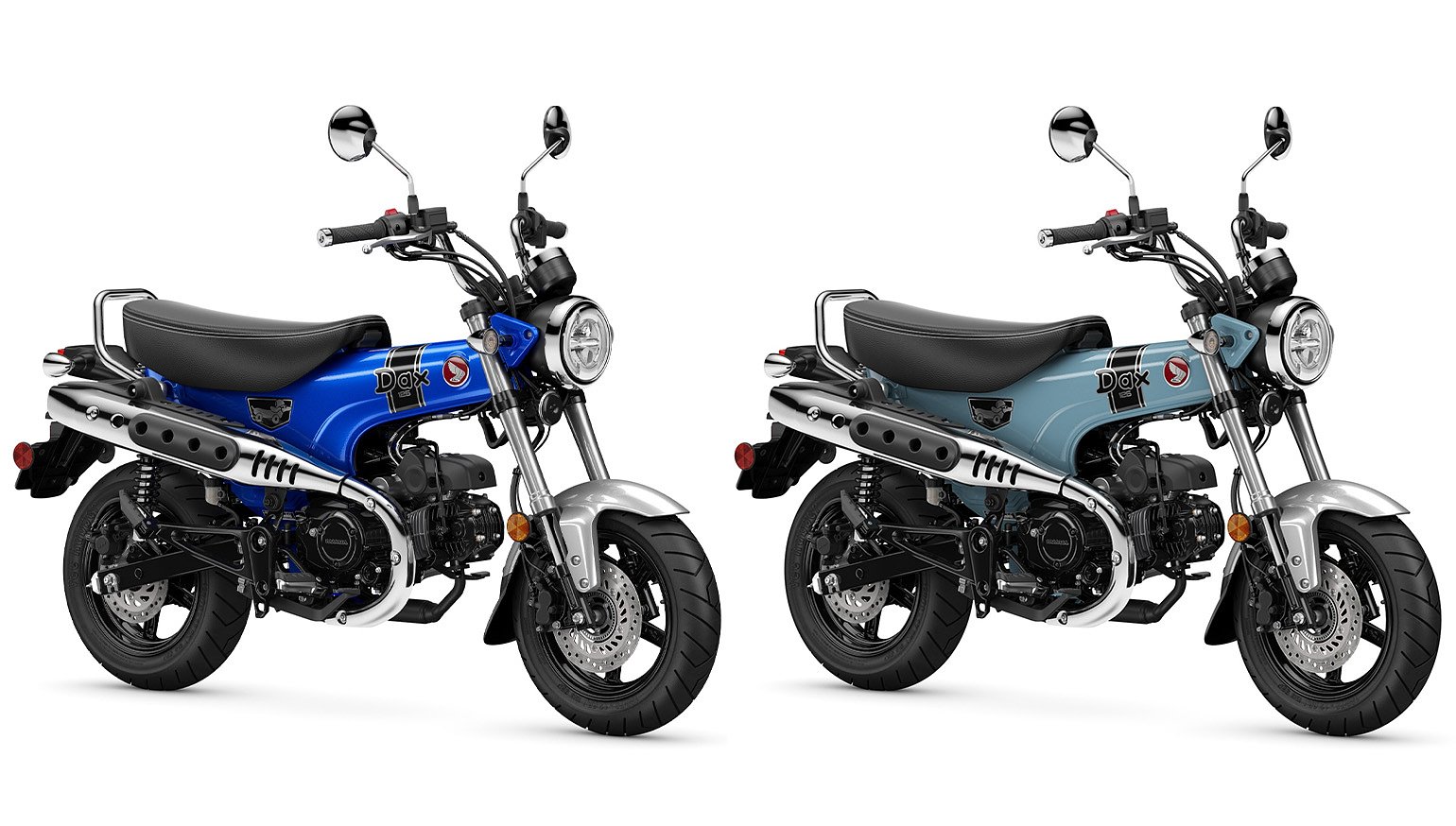
In 2023, Honda added the Dax 125 to its popular miniMOTO lineup. There was just one problem. Big Red only sent the model to Europe. That all changes in 2025, when the Dax 125 will finally make its way to North America.
The Dax will arrive with the same air-cooled 124 cc single-cylinder engine that anchors other retro-leaning miniMOTOs like the Super Cub, Trail 125, and Monkey. Fuel injection and a four-speed semi-automatic transmission only make the mill that much more approachable. American Honda lists neither horsepower nor torque figures for the little thumper, but a claimed top speed of 55 mph is respectable for a minibike.
The model’s small stature also benefits its accessibility. With a 30.6-inch seat height and 236-pound reported wet weight, the Dax caters to riders of various sizes and ages. Agility isn’t lost on the newest miniMOTO either, as its 25-degree rake, 3.3-inch trail, and 47.2-inch wheelbase favor light handling.
Starting at $4,199, the 2025 Dax 125 is the second most expensive miniMOTO model behind the $4,399 Monkey. Honda estimates that the first North American-bound units will roll into showrooms in October 2024. The Dax may be late to arrive in the states but at least we won’t have to wait much longer.
2025 Honda Dax 125
Price (MSRP)
$4,199
Engine
124 cc, air-cooled, two-valve, single
Transmission, final drive
Four-speed semi-automatic, chain
Claimed horsepower
N/A
Claimed torque
N/A
Frame
Pressed steel
Front suspension
31 mm fork; 3.9 inches of travel
Rear suspension
Twin shocks; 4.7 inches of travel
Front brake
Two-piston caliper, 220 mm disc with ABS
Rear brake
Single-piston caliper, 190 mm disc
Rake, trail
25.0 degrees, 3.3 inches
Wheelbase
47.2 inches
Seat height
30.6 inches
Fuel capacity
1.0 gallons
Tires
120/70-12 front, 130/70-12 rear
Claimed weight
236 pounds
Available
October 2024
Warranty
12 months
More info
powersports.honda.com
Happy
00 %
Sad
00 %
Excited
00 %
Sleepy
00 %
Angry
00 %
Surprise
00 %
We use cookies on our website to give you the most relevant experience by remembering your preferences and repeat visits. By clicking “Accept”, you consent to the use of ALL the cookies.
This website uses cookies to improve your experience while you navigate through the website. Out of these, the cookies that are categorized as necessary are stored on your browser as they are essential for the working of basic functionalities of the website. We also use third-party cookies that help us analyze and understand how you use this website. These cookies will be stored in your browser only with your consent. You also have the option to opt-out of these cookies. But opting out of some of these cookies may affect your browsing experience.
Necessary cookies are absolutely essential for the website to function properly. These cookies ensure basic functionalities and security features of the website, anonymously.
Cookie
Duration
Description
cookielawinfo-checbox-analytics
11 months
This cookie is set by GDPR Cookie Consent plugin. The cookie is used to store the user consent for the cookies in the category "Analytics".
cookielawinfo-checbox-functional
11 months
The cookie is set by GDPR cookie consent to record the user consent for the cookies in the category "Functional".
cookielawinfo-checbox-others
11 months
This cookie is set by GDPR Cookie Consent plugin. The cookie is used to store the user consent for the cookies in the category "Other.
cookielawinfo-checkbox-necessary
11 months
This cookie is set by GDPR Cookie Consent plugin. The cookies is used to store the user consent for the cookies in the category "Necessary".
cookielawinfo-checkbox-performance
11 months
This cookie is set by GDPR Cookie Consent plugin. The cookie is used to store the user consent for the cookies in the category "Performance".
viewed_cookie_policy
11 months
The cookie is set by the GDPR Cookie Consent plugin and is used to store whether or not user has consented to the use of cookies. It does not store any personal data.
Functional cookies help to perform certain functionalities like sharing the content of the website on social media platforms, collect feedbacks, and other third-party features.
Performance cookies are used to understand and analyze the key performance indexes of the website which helps in delivering a better user experience for the visitors.
Analytical cookies are used to understand how visitors interact with the website. These cookies help provide information on metrics the number of visitors, bounce rate, traffic source, etc.
Advertisement cookies are used to provide visitors with relevant ads and marketing campaigns. These cookies track visitors across websites and collect information to provide customized ads.