
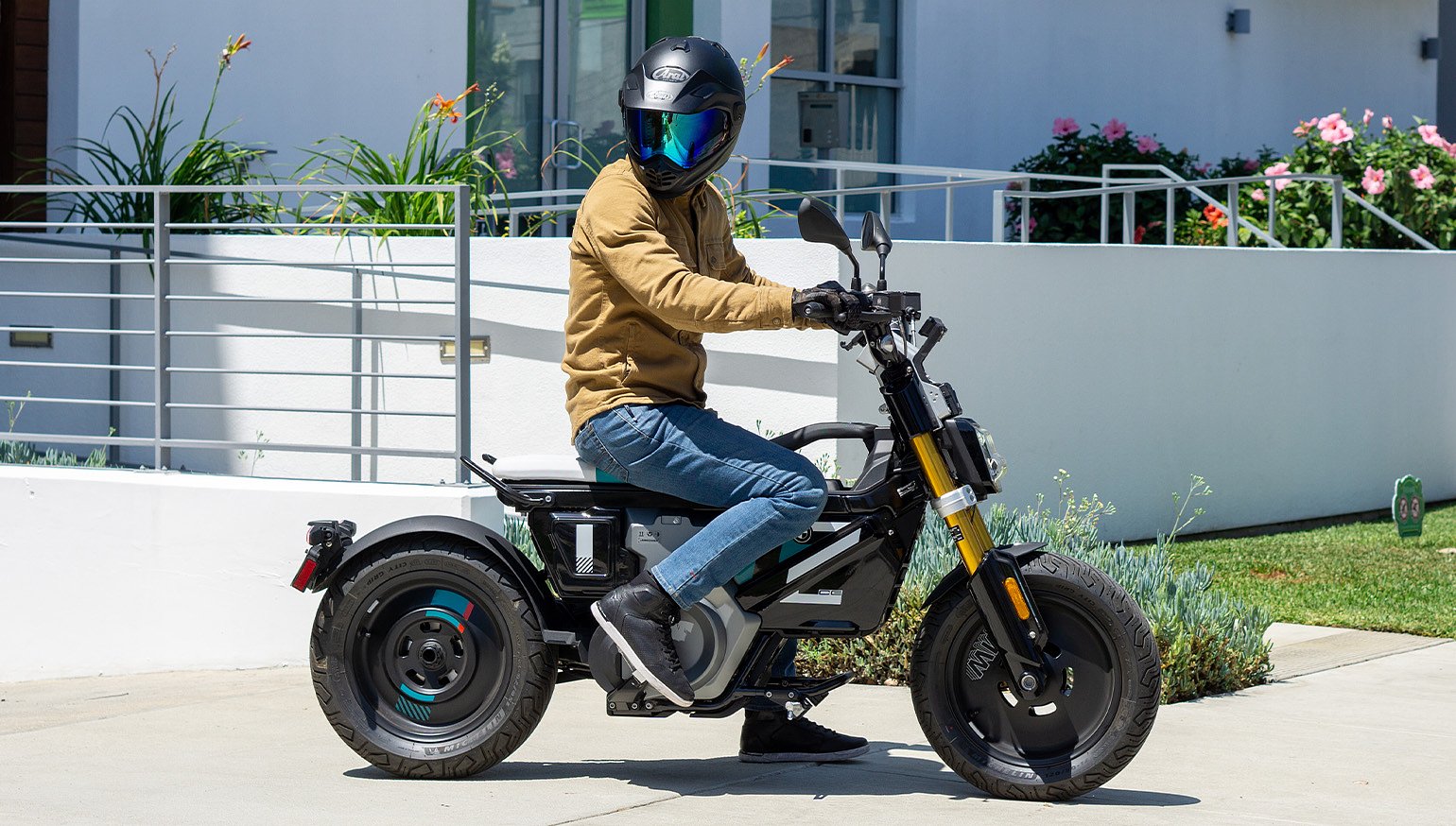
Electric vehicles already fight an uphill battle. They often cost more than their petrol-powered counterparts and rarely achieve the same range. Gas stations far exceed the number of charging stations and charge times far exceed fueling times. These factors place EVs at a marked disadvantage. That’s especially true for two-wheeled vehicles.
Similar to its competition, the e-scoot handles best in close quarters. It picks through traffic like a mouse in a maze. That’s thanks in part to its narrowness and lightweight construction. With much of its weight centrally located (and no top-heavy fuel tank to bear), the zero-two is impeccably balanced. Steering is predictable and precise, the two attributes you want when negotiating the millimeters between your handlebar and a car’s side mirror.
The CE 02 is just as comparable in the power department. Many 125-class models top out around 55 to 60 mph. BMW claims a 59 mph top speed for the CE. That’s not giving it full credit, though. The speedometer often reads 63 mph before the 02 limits further acceleration; a laudable figure considering that BMW lists the air-cooled, current-excited synchronous motor at 8 horsepower (15 horsepower peak).
At the same time, BMW believes the e-scooter performs equivalent to a 200 cc combustion engine, which explains the “02” surname. That might be a gap too far to bridge, unfortunately. California prohibits motorcycles and scooters under 150 cc from freeway use. Although BMW positions the model as 200 cc-equivalent, its stature and performance is much more akin to a 125 cc mini-moto. And yet, the CE 02 is still permitted on the freeway.
California’s 150 cc restriction only applies to motorcycles and scooters powered by internal combustion engines, not electric motors. Low-speed electric vehicles are also banned on Golden State freeways, but the CE 02 doesn’t qualify for that category either. Still, the thought of merging onto Interstate 405 at full speed was nothing short of nightmare fuel. That’s why I often clung to city streets, where the CE 02 truly belongs.
Charging challenges
To keep the CE 02’s weight manageable, BMW elected for an air-cooled motor. Lower-voltage systems don’t necessitate liquid cooling, saving weight, in turn. That build philosophy extends beyond the motor itself. Instead of integrating the charging electronics into the vehicle, BMW built them into its charger pack. About the size of a first aid kit, the external charger wouldn’t be such an inconvenience if it wasn’t the only way to recharge the electric scooter.
Because the low-voltage e-scooter doesn’t support Level 2 charging, BMW developed a proprietary socket. This limits the model to wall outlets, as charging station plugs aren’t compatible with the CE 02’s port. That doesn’t pose a problem if you can complete your round trip on a single charge. My daily commute isn’t one of those trips.
At a distance
The CE’s two 1.96 kWh lithium-ion batteries carry a total charge of 3.92 kWh, which theoretically nets a maximum range of 56 miles, per BMW. One factor that greatly influences the practical range is the selected ride mode. The base model comes standard with Flow (gentle acceleration and medium regenerative braking) and Surf (direct throttle response and no regen). The optional Flash mode, which is exclusive to the Highline package, pairs dynamic acceleration with aggressive regen.
While Flow is easily the most conservative and economical setting, Flash often yielded more mileage than Surf. I chalk that up to Flow and Flash’s regenerative braking. To me, riding an electric without using regen is like frying bacon without a shirt. High risk, low reward. Sure, regen only recovers an extra mile or two over the course of the trip, but that could be the difference between reaching or not reaching your destination. Or in the CE 02’s case, reaching your destination or calling a tow truck.

The e-scooter has several things going for it. It’s quick off the line. It’s light, agile, and well-suspended. Like most electrics, it’s also user-friendly. The CE 02 can be everything BMW says it is — creative, fun, and stylish — but its limitations often overshadow those strengths. The lack of charging compatibility is chief among them. Electric charging infrastructure (or lack thereof) already deters many would-be adopters. The model’s limited charging options, in addition to its limited top speed and range, only stand to deter more.


